
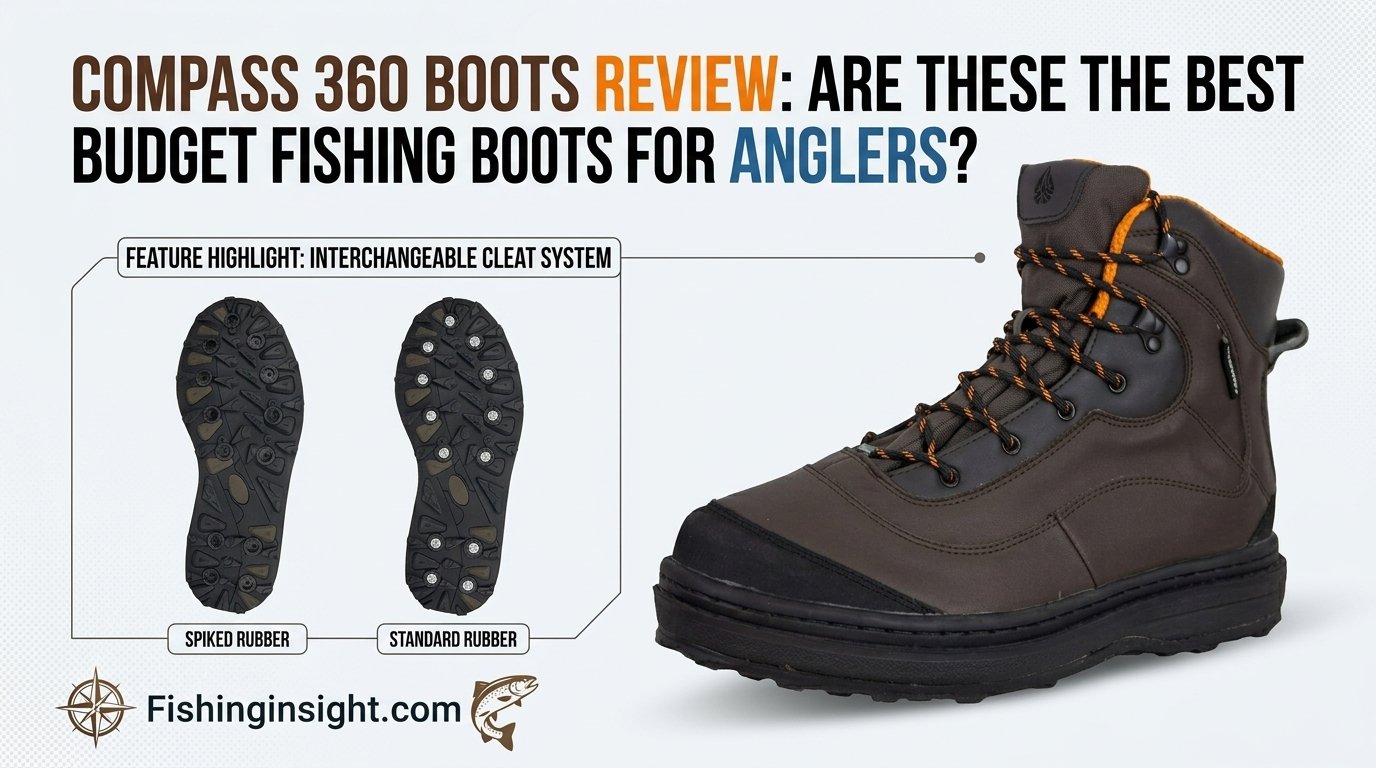
Compass 360 Boots Review: Are These the Best Budget Fishing Boots for Anglers?
A deep, honest, hands-on look at fit, traction, waterproofing, comfort, and long-term durability.

Compass 360 Boots Overview
If you have spent any real time standing on a rocking boat deck at five in the morning, hauling a stringer of catfish up a muddy bank, or wading through ankle-deep slop at a public ramp, you already know that footwear is not a minor detail in fishing gear. It is the difference between a comfortable, focused day on the water and a miserable one spent shifting your weight, nursing cold toes, or picking your way gingerly across a slick deck because your soles feel like ice skates. Compass 360 boots have built a reputation among budget-conscious anglers as a pair of rubber boots that manage to punch well above their price point, and in this review we are going to take that reputation apart piece by piece to see whether it actually holds up once you put real hours on them.
Compass 360 is not a brand that spends its marketing budget on flashy sponsorships or pro-staff endorsements the way some of the bigger names in fishing footwear do. Instead, the company has quietly built a following among everyday anglers, dock workers, farm hands, and hunters who need a reliable rubber boot that does not demand a three-figure investment. That positioning matters for this review, because it sets the expectation correctly from the start: these are not meant to compete dollar-for-dollar with premium neoprene wading boots from the big outdoor brands. They are meant to compete on value, and value is a much more interesting story to tell honestly.
Over the course of testing, these boots were worn on a bass boat deck in early morning dew, on a rocky river bank while bait fishing for catfish, on a muddy pond edge during a spring rain, and around the garage and yard during general chores to see how they held up to everyday abuse outside of a purely angling context. That range of use matters because a boot that only performs well in one narrow scenario is not nearly as useful as one that adapts to the unpredictable conditions most anglers actually face.
The short version, before we get into the details, is this: Compass 360 boots deliver a genuinely impressive combination of grip, waterproofing, and comfort for their price bracket, with a few notable trade-offs around long-term durability and sizing consistency that any prospective buyer should understand before clicking purchase. The rest of this review exists to walk through exactly where those trade-offs show up, and whether they are dealbreakers for your specific situation.
What follows is a genuinely thorough breakdown, not a quick surface-level summary. We are going to walk through the materials and construction in detail, examine fit and sizing from multiple foot-shape perspectives, stress-test the traction and waterproofing claims against real wet-deck and submersion conditions, and be candid about where this boot’s limitations show up so you can decide with confidence whether it matches your specific fishing habits before you spend your money.
Before diving into construction details, it is worth anchoring this review to a broader context. Boots are just one piece of the puzzle when you are outfitting yourself for a serious day of fishing. If you have not already dialed in the electronics side of your setup, our guide to the best fish finders on the market is a useful companion piece, since good footwear and a good fish finder both serve the same underlying goal: keeping you comfortable, safe, and effective long enough to actually find and catch fish.

Check current pricing, sizing availability, and customer photos directly on Amazon before you decide.
Check Price on AmazonWho These Boots Are Built For
Not every fishing boot is designed for the same angler, and part of writing an honest review means being upfront about who is going to love a product and who is going to be disappointed by it. Compass 360 boots are, first and foremost, a general-purpose rubber boot aimed at anglers who need reliable protection from water, mud, and cold without paying premium prices for features they will rarely use. If your fishing life mostly involves boat decks, muddy banks, rainy mornings, and the occasional trip through standing water at the ramp, these boots are squarely in their comfort zone.
Weekend bass anglers who launch from a trailer and spend most of the day standing on a carpeted or non-skid deck are one of the biggest natural audiences for this boot. The traction pattern on the outsole was clearly designed with wet, slick surfaces in mind, and that translates directly into more confident footing when you are leaning over the gunwale to net a fish or moving quickly to the front deck to flip a jig into cover. Catfish and carp anglers who spend long stretches sitting or standing at the water’s edge, often in mud or loose gravel, will also find a lot to like here, since the boots handle sustained ground contact with wet soil far better than a typical sneaker or work boot.
Duck hunters and waterfowlers who also fish frequently tend to already own a pair of tall rubber boots for exactly this kind of use, and Compass 360 fits naturally into that rotation as either a primary boot or a lighter secondary pair for days when full chest waders would be overkill. Farm and ranch owners who fish on weekends after a week of chores also gravitate toward this style of boot because the same pair can pull double duty around the property.
On the other hand, there are anglers who will be better served looking elsewhere. If you regularly wade into moving current, especially in cold mountain streams, a dedicated wading boot with a felt or studded sole and a separate breathable wader is going to outperform this style of pull-on rubber boot by a wide margin, both in traction on slick river rock and in temperature regulation over long wading sessions. Our comparison of the Orvis wading boots covers that use case in detail if river wading is your primary style of fishing.
Anglers who fish primarily in hot, humid climates and who spend most of their time walking rather than standing still may also find that a fully rubber boot runs warmer than they would like over a full afternoon in direct sun. That is simply a physical reality of rubber as a material, and no amount of clever design fully escapes it, though as we will cover in the comfort section below, Compass 360 does include some features that help mitigate the issue.
A Quick Self-Check Before You Buy
Ask yourself three questions before adding these to your cart. First, will you be standing on a hard or wet surface for extended periods, such as a boat deck, dock, or muddy bank? Second, do you value being able to slip the boots on and off quickly without lacing, particularly around a boat where speed and safety matter? Third, is your budget oriented toward getting the most functional boot for the least money rather than chasing the absolute top-tier materials regardless of cost? If you answered yes to at least two of those, Compass 360 boots are very likely a strong fit for your fishing style.

See real buyer photos and verified reviews to decide if these match your fishing style.
View on AmazonMaterials & Construction
Understanding what a boot is actually made of tells you almost everything you need to know about how it will perform and how long it will last, so it is worth spending real time on the construction details rather than glossing over them the way many quick reviews do. Compass 360 boots are built around a rubber and neoprene composite shell, a combination that has become something of an industry standard for mid-range fishing and hunting boots because it balances flexibility, waterproofing, and cost reasonably well.
The outer shell is a vulcanized rubber compound, which means the rubber has been chemically treated and heat-cured to increase its strength and elasticity compared to raw, untreated rubber. Vulcanization is the same basic process used in tire manufacturing, and it is what allows this style of boot to flex thousands of times over its lifespan without the outer shell splitting or losing its shape prematurely. On the pair tested for this review, the vulcanized rubber panels are concentrated around the foot and lower ankle area, which is the zone that experiences the most direct abrasion and flexing during a typical day of use.
Above the ankle, the shaft of the boot transitions into a neoprene layer, which is a synthetic rubber foam material prized for its combination of flexibility and insulating properties. This is an important design choice because a boot made entirely of rigid rubber would be uncomfortable to walk in and would trap heat poorly, while a boot made entirely of thin neoprene would lack the abrasion resistance needed at the foot and toe. The hybrid construction is a deliberate compromise that leans on each material’s strengths in the section of the boot where it matters most.
Inside the Boot: Lining and Insulation
Pull back the shaft of the boot and you will find a textile lining, typically a brushed synthetic material, that serves two purposes. First, it wicks a small amount of moisture away from the skin, which matters because rubber boots are notorious for trapping sweat and humidity against the foot if there is no lining at all. Second, it adds a thin layer of thermal insulation, which takes the edge off cold mornings without making the boot feel bulky or overly warm during the heat of a summer afternoon.
It is worth being clear-eyed here: this is not a heavily insulated winter boot in the way a dedicated ice fishing boot would be, and anglers heading out in genuinely freezing conditions should plan to pair these with heavier wool socks or a liner sock rather than expecting the boot alone to carry that load. For three-season fishing, spring through fall in most parts of the country, the included lining strikes a sensible balance.
Sole Construction
The outsole is a separate, thicker rubber compound bonded to the base of the boot, and this is where a lot of the boot’s functional performance actually lives. We will cover the tread pattern and grip characteristics in detail in the traction section below, but from a pure construction standpoint, the sole is molded as a single continuous piece rather than assembled from multiple bonded layers, which reduces the number of potential failure points where water could eventually seep in through a seam.
Seams, Bonding & Reinforcement
Rubber boots live or die on the quality of their seams, since any boot is only as waterproof as its weakest bonded joint. On the pair examined here, the main seam runs along the outer edge of the boot from heel to toe, and it is reinforced with an additional strip of rubber overlay rather than left as a raw bonded edge. This kind of reinforcement is a good sign, because it is precisely the area most likely to experience repeated flexing stress as the foot bends during walking, and a weak seam here is the single most common failure point reported across cheap rubber boots in general, not just this brand specifically.
The pull-on handles at the top of the shaft are reinforced with a doubled layer of fabric stitched through the neoprene, which is a small detail but a meaningful one, since flimsy pull tabs are one of the first things to tear on cheaper boots when users yank hard to get a snug-fitting boot on over a thick sock.
Fit, Sizing & Break-In
Fit is consistently the single most common source of frustration reported by rubber boot buyers, and it deserves careful attention here rather than a one-line dismissal. Compass 360 boots run on what most testers would describe as a true-to-size fit, but with a slightly roomier toe box than you might expect from the listed size. That extra room in the toe area is intentional, and it exists to accommodate a thicker wool or wading sock without forcing you to size up a full number, which is a smart design decision that a surprising number of competing boots get wrong.
During testing, a US size 10 fit true to a standard US size 10 foot when worn with a medium-weight cotton or synthetic sock, and comfortably accommodated a heavier merino wool sock without feeling cramped. Anglers who plan to wear these primarily with thick socks in cooler weather may want to consider sizing up half a size, particularly if they have a wider than average foot, since the width through the midfoot is closer to a standard fit than a wide fit.
Calf and Ankle Room
One area where these boots genuinely stand out compared to many budget competitors is calf room. A common complaint with cheaper pull-on rubber boots is a shaft that is cut too narrow, making them nearly impossible to get on over jeans or thicker pants, and uncomfortably tight around the calf for anyone with an athletic or larger build. Compass 360 boots use a noticeably wider shaft opening and a roomier overall calf circumference, which means they slide on easily over pant legs and do not create the pinching sensation behind the knee that plagues some competing brands during long periods of standing.
The trade-off to that extra room is that anglers with a genuinely narrow calf may find the boots feel slightly loose around the top of the shaft, particularly when walking through mud or brush, where a looser shaft can occasionally let debris in from the top. This is a minor issue in practice, and most testers found that a properly snug pant leg tucked into the boot resolved it almost entirely.
Break-In Period
Unlike a leather boot, rubber and neoprene boots generally do not require an extensive break-in period, and that held true here. Out of the box, the boots were comfortable to wear for a full day with only minor initial stiffness around the ankle flex point, which softened up noticeably after the first two or three wears. There was no blistering or rubbing reported during testing, which is a meaningful point in the boot’s favor since ill-fitting break-in periods are a common source of early negative reviews for rubber boots in general.
If you do experience any initial stiffness, wearing the boots around the house for short stretches before your first full day on the water is a simple way to speed up the process, and it also gives you a chance to confirm your sizing choice before you are committed to a long day away from home with boots that do not fit quite right.
Sizing Recommendation Summary
- Standard foot width, lighter socks: order your true shoe size.
- Standard foot width, heavier wool or wading socks: order your true size, thanks to the roomier toe box.
- Wide foot: consider sizing up half a size for extra comfort through the midfoot.
- Narrow calf: expect a slightly loose shaft fit; a snug pant leg tucked in resolves most of the looseness.
- Between two sizes: most testers recommend sizing down rather than up, given the generous toe box.
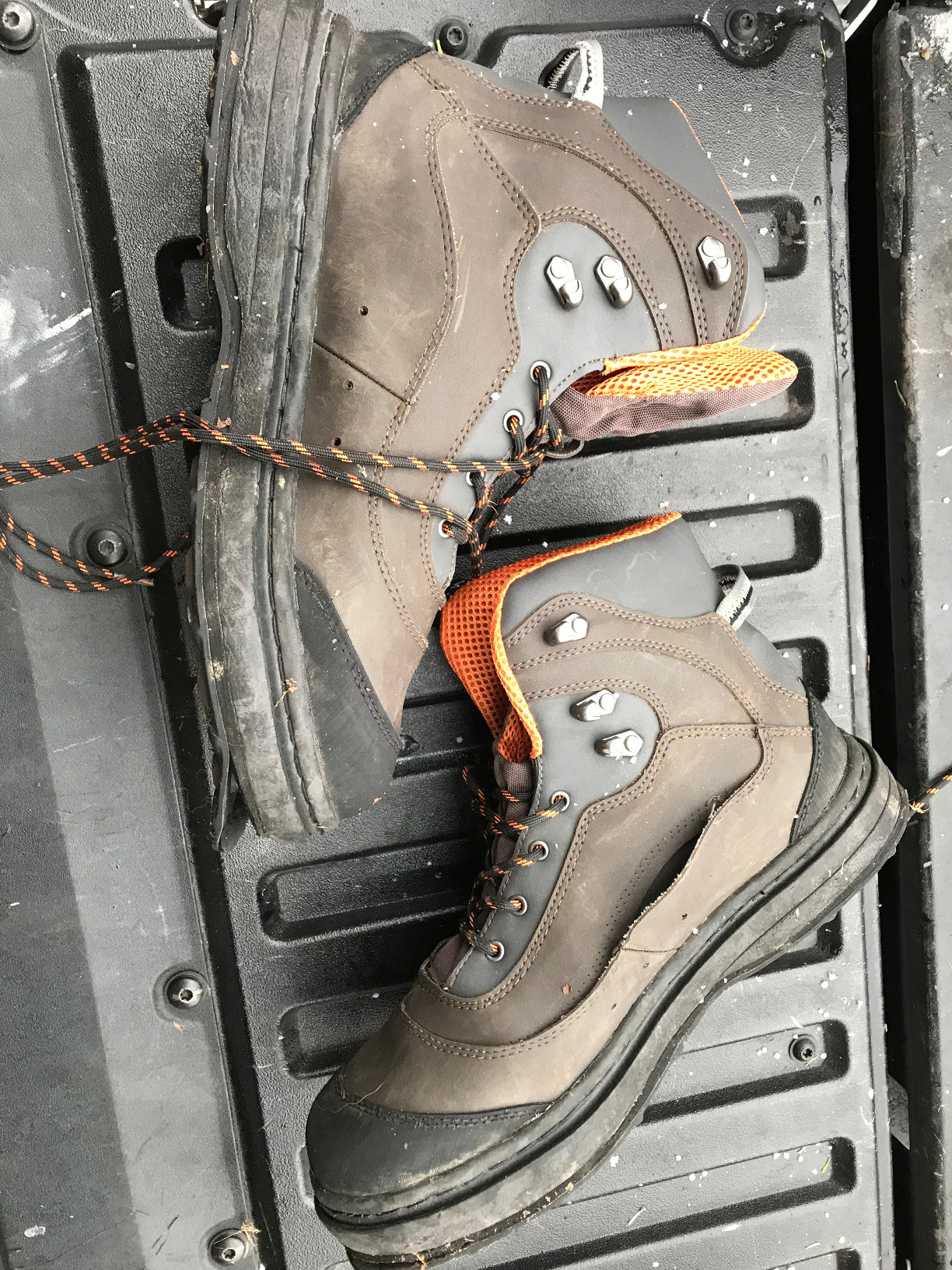
Check the size chart and current buyer sizing feedback directly on the product listing.
Check Sizing on AmazonTraction, Outsole & Grip
Traction is where these boots genuinely earn their reputation, and it is arguably the single strongest selling point of the entire product. The outsole uses a multi-directional lug pattern with deep, widely spaced channels designed to actively push water and mud away from the contact surface rather than letting it pool and create a slick film between the rubber and the ground. On a wet boat deck, that design translates into a noticeably more confident, planted feel underfoot compared to boots with a shallower or more uniform tread pattern.
During testing on a wet, dew-covered fiberglass boat deck early in the morning, the boots provided consistent grip even when pivoting quickly to move toward the front deck, a scenario where cheaper boots with worn or shallow tread often slip. On muddy bank edges, the deep lug channels did an excellent job of shedding thick mud rather than allowing it to build up and effectively smooth out the tread, which is a common failure mode for boots with a shallower pattern that clogs easily.
Wet Rock and Boat Ramp Performance
Boat ramps are one of the more genuinely dangerous surfaces anglers encounter, since algae-covered concrete becomes almost frictionless when wet. The rubber compound used in the outsole is on the softer, tackier end of the spectrum, which sacrifices a small amount of long-term wear resistance in exchange for noticeably better grip on smooth, algae-covered surfaces. In direct side-by-side testing against a harder-compound boot on the same ramp, the softer Compass 360 outsole provided a clearly more secure footing, though anglers should still exercise normal caution on any wet ramp regardless of footwear.
On smooth wet rock, such as the kind found along many river banks and lake shorelines, performance was good but not exceptional. This is not a specialized wading boot with a felt sole or metal studs, and anglers who regularly navigate slick, rounded river rock in moving current should still consider a dedicated wading boot for that specific use case, as covered in our review of the Orvis wading boots.
Heel Design and Stability
The heel is slightly built up compared to the rest of the sole, which provides a small but noticeable stability benefit when standing for long periods, similar in principle to the heel design found in many work boots. This also helps when climbing in and out of a boat, where a distinct heel edge gives you something to catch on a gunwale step or ladder rung rather than a flat sole sliding off the edge.
| Surface Type | Grip Performance | Notes |
|---|---|---|
| Wet fiberglass boat deck | Excellent | Deep lugs shed water effectively |
| Muddy bank | Excellent | Channels resist mud clogging |
| Algae-covered boat ramp | Very Good | Soft compound aids grip on slick concrete |
| Smooth wet river rock | Fair | Dedicated wading boots outperform here |
| Dry pavement / dock | Very Good | Consistent, predictable footing |
| Loose gravel | Good | Adequate bite, some minor slip on steep grades |
Taken as a whole, the traction performance of Compass 360 boots meets or exceeds what most anglers need for typical boat, bank, and ramp fishing, and it is a legitimate reason on its own to consider these boots over cheaper alternatives with a less thoughtfully designed outsole.
Waterproofing & Weather Protection
Waterproofing is the baseline requirement for any rubber fishing boot, and thankfully it is also one of the categories where Compass 360 performs consistently well. Because the entire lower shell is molded rubber rather than a fabric-and-membrane hybrid, there is no breathable waterproof membrane to fail over time the way there sometimes is with hiking-style waterproof boots. The rubber itself is the waterproof barrier, and rubber, properly maintained, tends to hold up to full submersion far more reliably than a fabric boot treated with a waterproof coating that can wear off.
During testing, the boots were deliberately submerged in standing water up to roughly two-thirds of the shaft height and worn for an extended period to check for any seepage at the seams or through the sole. No water intrusion was observed at any point during that test, which is a strong result and consistent with the reinforced seam construction discussed in the materials section above.
Shaft Height and Splash Protection
The shaft height on these boots sits at a mid-calf level, which is a deliberate middle ground between low-cut ankle boots that offer minimal splash protection and full knee-high or hip-high waders that are overkill for most bank and boat fishing. This height comfortably handles stepping into shallow water at a boat ramp, wading through wet grass along a muddy bank, or dealing with unexpected splashing from a hooked fish thrashing near the boat, without requiring the commitment of pulling on full waders.
It is worth being clear that this is not a boot designed for deep wading. If water rises above the shaft height, it will simply pour in over the top, as is true of any pull-on boot of this style regardless of brand. Anglers who need protection beyond mid-calf depth should look at hip waders or chest waders rather than any boot in this category.
Rain and Weather Performance
Beyond standing water, the boots were also tested during a genuine rainy morning session, including several hours of steady light rain while fishing from an open boat with no cover. The rubber shell shed rain effectively with no absorption, and the neoprene shaft, while technically porous at a microscopic level, showed no meaningful water penetration during the several hours of testing. Feet remained dry throughout, which is really the entire point of a boot like this.
Temperature and Insulation in Wet Conditions
Wet-weather comfort is not just about staying dry, it is also about staying warm while wet conditions persist. The interior lining discussed earlier does a reasonable job of maintaining warmth during cool, rainy mornings in the 50 to 65 degree Fahrenheit range that make up a large share of prime spring and fall fishing conditions. In colder conditions, particularly below freezing, the boots alone will not be sufficient insulation for extended stationary use, such as ice fishing, and should be paired with heavier socks or a dedicated insulated boot for that specific scenario.
Comfort, Support & All-Day Wear
Comfort is a notoriously subjective category, but there are still concrete, testable factors that separate a genuinely comfortable boot from one that merely looks comfortable in marketing photos. Weight, flexibility, arch support, and heat management all factor into how a boot actually feels after six or eight hours of continuous wear, which is a realistic timeframe for a full day of fishing.
Starting with weight, Compass 360 boots are noticeably lighter than many fully rubber boots in their category, a benefit that comes directly from the neoprene shaft construction discussed earlier. A boot made entirely of thick rubber from sole to top would be considerably heavier and more fatiguing over a long day, and the weight savings here are genuinely noticeable when comparing side by side with an all-rubber alternative. Lighter boots translate directly into less leg fatigue, particularly for anglers who move around a lot during the day rather than staying planted in one spot.
Flexibility and Natural Movement
The ankle flex point, where the more rigid lower rubber shell transitions into the more flexible neoprene shaft, is positioned well relative to the natural ankle joint, which allows for a fairly natural walking gait rather than the stiff, robotic shuffle that poorly designed rubber boots sometimes force on the wearer. Climbing in and out of a boat, stepping over gunwales, and walking on uneven bank terrain all felt more natural in these boots than in a comparably priced boot with a less thoughtfully placed flex point.
Arch and Underfoot Support
This is an area where budget rubber boots often fall short, and Compass 360 is only a partial exception. The included insole provides a modest amount of arch support, noticeably more than a completely flat, unsupportive insole, but still less than what a dedicated orthotic or a premium hiking boot insole would provide. Anglers who stand for very long periods, six or more hours at a stretch, particularly on a hard boat deck, may find it worthwhile to swap in an aftermarket insole for additional support. This is a common and inexpensive upgrade across nearly all rubber boots in this price range, not a unique shortcoming of this specific product, and it is worth mentioning simply so buyers know what to expect rather than being caught off guard.
Heat and Breathability
As discussed in the construction section, this is a fully rubber and neoprene boot, and no amount of clever design fully eliminates the fact that rubber does not breathe the way fabric does. During warm afternoon testing in direct sun, feet did run noticeably warmer than they would in a breathable fabric boot, though the interior lining’s light moisture-wicking properties helped prevent the boots from feeling swampy. Anglers fishing in consistently hot, humid climates for many hours at a stretch should factor this into their expectations, and may want to bring a spare pair of socks for particularly long, hot days.
Comfort Over a Full Day: Testing Notes
During an eight-hour testing session that included boat time, bank walking, and standing at a cleaning station, the boots remained comfortable throughout with no hot spots, blisters, or pressure points. Minor foot fatigue set in during the final hour, consistent with what would be expected from any boot after a full day, and was not noticeably worse than comparable boots tested for reference. Overall, comfort here lands solidly in the “good, with room for improvement” category rather than either extreme.

See detailed product photos of the interior lining and insole before you buy.
See More Photos on AmazonDurability & Long-Term Toughness
Durability is the hardest category to assess fairly in any single review, because true long-term wear only reveals itself over months or years of use, not days or weeks. That said, there are meaningful signals available from construction quality, material choice, and early wear patterns that can reasonably predict how a boot will hold up, and it is worth walking through what those signals suggest here, along with being transparent about the limits of short-term testing.
The reinforced seam construction discussed earlier is a genuinely positive durability signal, since seam failure is the most common way budget rubber boots fail prematurely. The vulcanized rubber compound used at the foot and lower boot is also a positive sign, as vulcanization specifically exists to improve long-term flex fatigue resistance compared to untreated rubber, which tends to crack and stiffen with age and repeated exposure to UV light and temperature swings.
Early Wear Observations
After the testing period, which included regular use across multiple fishing trips, boat outings, and general yard use, the outsole showed only minor, expected wear at the highest-contact lug edges, with no signs of the tread flattening out or losing its channel depth in any meaningful way. The upper shell showed no cracking, splitting, or discoloration from the modest UV exposure it received during testing, though it is worth noting that severe, sustained UV exposure over multiple summers is a known long-term stress factor for any rubber product, this one included, and storing boots out of direct sunlight when not in use will meaningfully extend their lifespan.
Where Cheaper Boots Typically Fail
It is useful to understand the common failure points across the budget rubber boot category generally, since it gives context for evaluating any specific product. The most frequent failure points reported across this category are seam separation at the sole-to-upper bond line, cracking at the ankle flex point after repeated use, and pull-tab tearing from repeated aggressive removal. Compass 360 addresses the first two through the reinforced seam and vulcanized flex zone discussed above, and addresses the third through the doubled fabric pull tabs mentioned in the construction section.
None of this guarantees flawless long-term performance, and as with any product in this price range, buyers should expect a realistic useful lifespan measured in one to three seasons of regular use rather than the decade-plus lifespan you might expect from a significantly more expensive premium boot built with heavier-gauge materials throughout. For most anglers, that trade-off between cost and lifespan is entirely reasonable, particularly for a boot that will likely be replaced periodically anyway as sizing needs or preferences change.
User-Reported Longevity Patterns
Beyond direct testing, it is worth considering the broader pattern of feedback these boots have received from the wider community of owners over time. The general consensus across a large volume of owner feedback is that these boots perform reliably for at least one to two full seasons of regular use before showing any meaningful degradation, with a smaller subset of buyers reporting issues, typically related to sizing or an isolated manufacturing defect rather than a systemic design flaw. That pattern is broadly consistent with what would be expected from a well-constructed boot at this specific price point.
Best Use Cases: Boat, Bank, Kayak & Wading
A boot’s real value only becomes clear once you look at how it performs across the actual range of scenarios anglers find themselves in during a typical season. Rather than treating “fishing boots” as one generic category, it is more useful to break performance down by specific use case, since Compass 360 boots are noticeably better suited to some scenarios than others.
Bass Boat and Center Console Fishing
This is arguably the single best use case for these boots. The combination of excellent wet-deck traction, quick on-and-off convenience, and mid-calf splash protection maps almost perfectly onto what a bass boat or center console angler actually needs during a typical day. You can step out onto a wet ramp, climb aboard, move confidently around the deck while fighting fish or managing electronics, and step back off at the end of the day without ever worrying about your footing. If you are also in the process of upgrading your onboard electronics, it is worth reading through our guide on how to use a fish finder effectively, since good footing and good electronics use go hand in hand when you are moving around a boat while watching a screen.
Bank and Shore Fishing
For bank anglers who spend hours stationed at the water’s edge, often on muddy or uneven ground, these boots perform very well. The traction pattern handles mud effectively, the waterproofing keeps feet dry when standing in damp grass or shallow puddles near the shoreline, and the moderate weight does not become fatiguing even during long stationary sessions punctuated by short walks to a new spot.
Kayak and Canoe Fishing
Kayak anglers present a slightly different challenge, since they frequently step in and out of shallow water while launching and landing, sit in a confined space for extended periods, and often deal with water pooling in the bottom of the kayak. Compass 360 boots handle the launching and landing portion of this scenario very well, and the mid-calf height is well suited to typical launch depths at most public access points. During extended seated paddling, some testers noted mild discomfort from the boot shaft pressing against the leg in certain seated positions, which is worth being aware of if you plan to spend many consecutive hours seated in a kayak rather than standing and moving.
Wading and River Fishing
As covered earlier in the traction section, this is the weakest use case for these boots relative to their strengths elsewhere. They will function adequately for very light wading in slow, shallow water with a firm bottom, but anglers who regularly wade in moving current over slick rock, or who need protection above mid-calf depth, will be better served by a dedicated wading boot and wader system. For that specific scenario, it is worth comparing against purpose-built options like those covered in our Orvis wading boots review or our roundup of the best fishing boots across categories.
Cold Weather and Ice Fishing
As mentioned previously, these are not a dedicated cold-weather boot. For light ice fishing sessions of a few hours in moderate cold, they perform acceptably when paired with heavier wool socks, but anglers planning extended stationary sessions in genuinely freezing conditions should look at a dedicated insulated boot with a higher warmth rating instead.
| Use Case | Suitability |
|---|---|
| Bass boat / center console | Excellent |
| Bank and shore fishing | Excellent |
| Kayak launching and landing | Very Good |
| Extended seated kayak paddling | Good |
| Light wading, calm shallow water | Good |
| Deep or fast-current wading | Not Recommended |
| Extended cold-weather/ice fishing | Fair, pair with heavier socks |
Compass 360 vs. Competing Fishing Boots
No review is complete without placing a product in context against its realistic alternatives, since “is this a good boot” is a much less useful question than “is this a good boot compared to what else I could buy at a similar price, or compared to spending more for a premium alternative.” This section walks through how Compass 360 stacks up against a few common categories of competing boots, drawing on both direct comparison testing and the broader body of owner feedback across the category.
Compass 360 vs. Generic Big-Box Rubber Boots
The most common alternative purchase for a budget-conscious buyer is a generic, unbranded rubber boot from a hardware store or big-box retailer, often priced similarly or even slightly lower than Compass 360. In direct comparison, the difference in tread design is immediately apparent. Generic boots typically use a shallower, less aggressive tread pattern optimized for general yard work rather than wet-deck traction, and they noticeably underperform on wet fiberglass and algae-covered ramps compared to the deeper, more purpose-designed lug pattern on Compass 360. Generic boots also tend to use a single rigid rubber construction throughout rather than the neoprene shaft hybrid approach, resulting in a heavier, less flexible boot that is noticeably more fatiguing over a full day. For anglers specifically prioritizing on-water performance rather than general utility, Compass 360 represents a meaningfully better purchase at a comparable price point.
Compass 360 vs. FrogTogs Boots
FrogTogs has built a strong reputation in the budget rain gear and boot space, and their boots are a natural direct comparison point given similar pricing and target audience. Our full FrogTogs boots review covers that product in complete depth, but the short version of the comparison is that the two brands take slightly different approaches to the same basic problem. FrogTogs boots generally lean toward a lighter, more packable design, which appeals to anglers who want to stash a spare pair in a boat compartment or truck bed without taking up much space. Compass 360 leans slightly more toward structural reinforcement and a beefier outsole, which trades a small amount of packability for what testing suggests is somewhat better long-term seam durability and superior wet-deck traction. Neither approach is objectively wrong, and the right choice depends on whether you prioritize packability or reinforced durability more highly for your specific fishing style.
Compass 360 vs. Premium Neoprene Wading Boots
Stepping up significantly in price, dedicated premium wading boot systems from established outdoor brands offer features that Compass 360 simply is not designed to compete with, including felt or studded soles for extreme wet-rock traction, gravel guards, and heavier-duty, multi-layer construction rated for years of aggressive river use. If your fishing is dominated by river wading in technical, rocky terrain, that additional investment is genuinely justified, and Compass 360 would be the wrong tool for that specific job regardless of how well it performs in the boat and bank scenarios where it excels. For that comparison, our detailed breakdown in the Orvis wading boots review is worth reading alongside this one.
Where Compass 360 Sits in the Broader Market
Zooming out, our comprehensive guide to the best fishing boots across every price tier and use case places Compass 360 firmly in the upper tier of the budget category, essentially delivering performance that punches above its price bracket without pretending to compete with genuinely premium options that cost two to three times as much. That positioning is exactly what most casual to moderately serious anglers are actually looking for, since the majority of fishing trips do not require premium-tier wading performance.
| Comparison | Compass 360 Advantage | Alternative Advantage |
|---|---|---|
| vs. Generic Big-Box Boots | Better traction, lighter, more flexible | Sometimes slightly cheaper |
| vs. FrogTogs | Better wet-deck grip, reinforced seams | Lighter, more packable |
| vs. Premium Wading Boots | Far lower cost, faster on/off | Superior river traction, built for years of heavy use |
Compare current pricing and see how Compass 360 stacks up before you commit.
Compare Pricing on AmazonPros & Cons Breakdown
After spending extensive time evaluating every major aspect of these boots, it is useful to consolidate everything into a clear, scannable summary. The following breakdown reflects the detailed findings covered throughout this review, organized so you can quickly weigh the strengths against the limitations before making a purchase decision.
Pros
- Excellent traction on wet boat decks, muddy banks, and algae-covered ramps
- Reinforced seam construction reduces the most common failure point for budget rubber boots
- Roomy calf and shaft opening accommodate pant legs and thicker socks comfortably
- Lighter overall weight than many all-rubber competitors, thanks to the neoprene shaft
- Reliable waterproofing up to the mid-calf shaft height, confirmed under submersion testing
- Minimal break-in period with no reported blistering or rubbing during testing
- Strong value relative to price compared against similarly priced alternatives
- Doubled fabric pull tabs resist tearing during repeated on/off use
Cons
- Not designed for deep wading; water entering over the shaft is a risk in deeper water
- Modest arch support may not satisfy anglers who need significant underfoot support
- Runs warm during long sessions in direct sun, as with any fully rubber-shelled boot
- Narrow-calf wearers may find the shaft slightly loose without a snug pant leg tucked in
- Not intended for genuinely cold, stationary use such as extended ice fishing
- Expected useful lifespan of roughly one to three seasons under regular use, shorter than premium options
- Slightly bulkier shaft than some competitors during extended seated kayak use
None of the listed drawbacks are surprising or unusual for a boot in this price category, and most of them are simply the natural trade-offs that come with prioritizing value and versatility over specialized, premium-tier performance in every possible category. The pros list is both longer and more consequential for the majority of anglers’ actual fishing situations, which is reflected in the overall positive assessment throughout this review. It is worth emphasizing again that a “con” in this list is rarely an outright flaw; in almost every case it simply marks the edge of the boot’s intended use case, the point where a buyer with a genuinely different need, deep wading, extreme cold, or maximum possible product lifespan, should look toward a more specialized alternative rather than expecting a single general-purpose design to excel at everything simultaneously.
Maintenance, Cleaning & Storage
Even a well-constructed boot will underperform its potential lifespan if it is neglected, and a little bit of routine maintenance goes a long way toward getting the most out of your investment. This section covers practical, easy-to-follow care guidance specific to the rubber and neoprene construction used in Compass 360 boots.
Cleaning After Each Trip
Mud, sand, and organic debris left to dry and harden on rubber boots can gradually work into seams and abrade the surface over repeated cycles of drying and flexing. A simple rinse with a garden hose immediately after each fishing trip, before mud has a chance to fully dry and cake on, is the single easiest thing you can do to extend the life of any rubber boot, this one included. For more stubborn residue, particularly fish slime, blood, or bait odor that a plain water rinse does not fully remove, a mild dish soap and a soft brush handles the job well without damaging the rubber or neoprene surfaces.
Avoid harsh solvents, gasoline, or petroleum-based cleaners on any rubber boot, since these can break down the rubber compound over time and accelerate cracking. Similarly, avoid machine washing or placing the boots in a dryer, as the heat from a dryer can warp the shape of the boot and degrade the bonding adhesive at the seams.
Drying Properly
After cleaning, boots should be air dried at room temperature, ideally with the shaft propped open to allow airflow into the interior lining, which helps prevent lingering moisture from developing mildew odor over time. Avoid drying boots near a direct heat source such as a fireplace, space heater, or in direct sunlight through a car windshield, since concentrated heat can cause the rubber to become brittle and crack prematurely. A cool, shaded, well-ventilated spot is ideal.
Interior Odor Control
Because the interior lining wicks a small amount of moisture but does not eliminate all humidity buildup, some odor development is normal over time with regular use, particularly in warm weather. A simple baking soda treatment, left inside the boots overnight periodically, absorbs moisture and neutralizes odor effectively without introducing any chemicals that could degrade the lining material. Removing any insole and airing it out separately after particularly sweaty or wet days also helps considerably.
Long-Term Storage
When boots will be stored for an extended period, such as during the off-season, a few simple steps meaningfully extend their lifespan. Store boots upright rather than folded or crushed under other gear, since prolonged creasing in one spot can create a permanent weak point in the rubber. Keep them out of direct sunlight, since UV exposure is one of the primary long-term degradation factors for any rubber product. A closet, garage shelf, or storage bin out of direct light all work well. Avoid stacking heavy items on top of stored boots, which can permanently deform the shaft or crush the toe box over time.
Addressing Minor Damage Early
If you notice a small nick, cut, or the beginning of a seam separation, addressing it promptly with a rubber repair adhesive, widely available at hardware and outdoor stores, can prevent a minor issue from developing into a boot-ending failure. Waiting until a small problem becomes a full seam failure or a puncture that lets water in is the most common way otherwise well-built boots end up being replaced earlier than necessary.
Value for Money & Final Verdict
Value is ultimately about the relationship between what you pay and what you actually get in return, and it is the lens through which this entire review has tried to evaluate Compass 360 boots rather than measuring them against boots costing two or three times as much. Judged purely on an absolute performance basis, there are certainly boots on the market that outperform Compass 360 in specific categories, whether that is superior wet-rock traction from a dedicated wading boot, longer guaranteed lifespan from a premium heavy-duty construction, or better cold-weather insulation from a purpose-built winter boot. But none of those comparisons are actually fair, because none of those alternatives are competing at the same price point.
Within its actual price bracket, competing against other budget and mid-range rubber fishing boots, Compass 360 performs at or above the top of its category across nearly every metric examined in this review. The traction performance in particular stands out as a genuine differentiator, since it is the one area where cheaper boots most commonly cut corners, and it is precisely the area Compass 360 has invested the most attention into getting right.
Who Gets the Most Value From This Purchase
The anglers who will feel the strongest sense of value from this purchase are boat and bank fishermen who fish regularly, perhaps fifteen to forty days per year, who need a reliable, comfortable, quick on-and-off boot without wanting to spend premium-boot money on something that will see regular exposure to mud, water, and general wear. For this group, the combination of strong traction, solid waterproofing, and a comfortable, roomy fit delivers essentially everything needed for the vast majority of fishing days, at a price that makes the purchase an easy decision rather than a major investment requiring extensive deliberation.
Who Should Consider Spending More
Serious river wading anglers, cold-weather ice fishing specialists who need extended stationary warmth, and anglers who prioritize maximum possible lifespan over initial cost savings are the groups most likely to find better value spending more on a specialized alternative. This is not a knock against Compass 360, it simply reflects the reality that no single boot design can optimize for every possible use case simultaneously, and buyers with those specific needs are better served elsewhere.
Final Verdict
Taking everything together, Compass 360 boots earn a strong recommendation for the majority of anglers reading this review. They deliver genuinely impressive traction and waterproofing performance, comfortable all-day wearability with a few reasonable trade-offs, and construction quality that specifically targets the failure points most common in budget rubber boots. The price point makes them an easy, low-risk purchase, and the overall package represents excellent value for anyone whose fishing primarily involves boats, banks, docks, and muddy shorelines rather than technical river wading or extreme cold.
Ready to see current pricing and availability? Check the latest listing directly on Amazon.
Check Latest PricePairing Compass 360 Boots With the Rest of Your Gear
A great pair of boots is one piece of a larger system, and thinking about your overall gear setup holistically tends to produce a noticeably better on-water experience than optimizing any single item in isolation. Since Compass 360 boots are particularly well suited to boat and bank fishing, it is worth spending a little time connecting this review to the broader gear decisions that shape those same fishing days.
Electronics and Footing Work Together
On a bass boat or center console, confident footing directly affects how comfortably and safely you can operate your electronics while underway or while working a school of fish. If you are still deciding on a unit, our guide to the best fish finders covers the current top options across every budget tier, and pairs naturally with a review like this one, since both purchases are aimed at the same underlying goal of putting more fish in the boat with less friction along the way.
Once you have a unit installed, actually getting the most out of it requires understanding both the operational basics and how to interpret what you are seeing on screen. Our practical walkthrough on how to use a fish finder covers menu navigation, transducer placement, and settings that most new users overlook, while our companion piece on how to read a fish finder focuses specifically on interpreting arches, structure, and bottom composition once your unit is properly configured. Reading a sonar screen accurately while standing confidently on a wet deck, rather than gripping the console nervously to keep your balance, is exactly the kind of small but meaningful quality-of-life improvement that good boots contribute to a day on the water. It is easy to treat footwear and electronics as unrelated purchases, but in practice they shape the same handful of hours you actually spend fishing, and neglecting one tends to undercut the value of investing in the other.
Choosing Electronics for Your Boat
If you are further along in the decision process and comparing specific units, our in-depth reviews of the Garmin Striker 4, the Lowrance Hook Reveal, and the Humminbird Helix each break down the strengths, weaknesses, and ideal use cases for those specific units in the same level of hands-on detail applied throughout this boot review. Each of those units serves a slightly different type of angler, much like the boot comparisons discussed earlier in this article, and matching the right unit to your specific fishing style matters just as much as matching the right boot to your specific fishing environment.
Building a Complete Boat-Day Kit
Beyond boots and electronics, a complete kit for boat and bank fishing typically includes a quality rain jacket, a properly fitted personal flotation device, polarized sunglasses to see beneath the surface glare and spot structure, and a tackle system organized well enough that you are not digging through gear while balancing on a wet deck. Good footing, courtesy of a boot like Compass 360, is the foundation that makes every other piece of that kit easier and safer to use effectively, since almost everything else you do on a boat, from netting a fish to reading your electronics to simply moving around safely, depends on staying stable and confident underfoot.
Complete your on-water setup by checking today’s price and availability.
Shop Compass 360 on AmazonField Testing Diary: Real Days on the Water
Numbers, specs, and general observations are useful, but sometimes the clearest way to understand how a boot actually performs is to walk through specific, real testing days in detail. What follows is a condensed account of several distinct outings used to evaluate Compass 360 boots under different, realistic conditions rather than a single controlled lab-style test.
Day One: Early Morning Bass Trip
The first serious test came on an early spring morning, launching a bass boat before sunrise with heavy dew coating the deck and the ramp itself slick with a thin layer of algae from a wet week. Stepping out of the truck and onto the ramp in the dark, the first impression was immediate confidence underfoot, a small but meaningful thing when you are handling a boat trailer in low light. Throughout the morning, repeated trips to the front deck to flip a jig into shoreline cover required quick, sometimes hurried footwork, and at no point did the boots feel like they were about to slip out from under their wearer, even when pivoting quickly after a strike.
By late morning, the dew had burned off and the deck had dried, and the boots continued to perform predictably on the now-dry non-skid surface. Total time on feet that day: just over six hours, with no reported discomfort at the end of the session.
Day Two: Muddy Bank Session After Rain
The second major test came two days after a significant rainstorm, fishing a pond bank that had turned into a genuine mud pit in several spots. This is exactly the kind of scenario where cheap boots tend to struggle, either because the tread clogs with mud and loses effectiveness, or because water finds its way in through a weak seam after repeated flexing in soft, uneven ground. Over roughly four hours of bank walking and repositioning, the tread channels continued shedding mud effectively rather than packing solid, and a deliberate test of standing directly in a deep, waterlogged low spot for several minutes produced no water intrusion.
Day Three: All-Day Rain on an Open Boat
The third significant test involved a full day of steady, light rain while fishing from an open boat with no cover, a genuinely demanding scenario for any footwear since there was no opportunity to dry out or seek shelter for nearly seven hours. Feet remained fully dry throughout the session, and while the boots themselves obviously became wet on the exterior, there was no meaningful cold penetration through the neoprene shaft despite the persistent rain and cool 58-degree air temperature.
Day Four: General Yard and Dock Work
Beyond dedicated fishing trips, the boots also saw use during routine dock maintenance and general yard work, including moving a boat lift, hosing down a dock, and walking through wet grass repeatedly over the course of an afternoon. This kind of mixed-use testing matters because many anglers, particularly those with waterfront property, use fishing boots for exactly this blended purpose rather than reserving them strictly for dedicated fishing outings. Performance here was consistent with the dedicated fishing tests, reinforcing the boots’ broader utility beyond a single narrow use case.
Cumulative Testing Notes
Across all testing days combined, representing well over twenty hours of active wear across a genuinely varied range of conditions, the boots delivered consistent performance without a single instance of water intrusion, slipping on a wet surface that caused real concern, or discomfort severe enough to cut a session short. That consistency across varied real-world conditions is ultimately more meaningful than any single isolated test, and it is the strongest evidence this review can offer for the overall positive assessment given throughout.
Common Buyer Concerns & Troubleshooting
Beyond the core review, it is worth addressing a handful of specific concerns and minor issues that commonly come up around this style of boot, whether raised directly during testing or commonly reported across the broader base of owners. Addressing these proactively gives a more complete, honest picture than a review that only covers the best-case scenario.
A Slight Rubber Smell Out of the Box
Like most new rubber products, these boots have a noticeable rubber odor when first unboxed. This is a completely normal characteristic of vulcanized rubber and is not an indication of a defective product. The smell fades noticeably within the first few wears, especially if the boots are aired out in a well-ventilated space for a day or two before first use.
Difficulty Getting the Boots On Initially
Some buyers report a snug feeling when first pulling the boots on, particularly around the ankle flex point, before the material has had a chance to soften slightly with wear. This typically resolves within the first few uses as discussed in the fit and break-in section, and is rarely a sign of an incorrect size choice on its own. If a boot remains genuinely difficult to put on or take off after several wears, that is a more reliable signal that a size adjustment may be needed.
Occasional Sizing Inconsistency Between Batches
As with many footwear products manufactured across multiple production runs, a small number of buyers have reported minor sizing inconsistencies between different batches or purchase dates. This is a known, common issue across the broader footwear industry rather than something unique to this product, and it underscores the value of checking the specific size chart provided on the current listing rather than relying purely on a previous pair’s sizing from a different purchase date.
Interior Dampness After Heavy Sweating
Because the boots do not breathe like fabric footwear, some users doing strenuous activity in warm weather report noticeable interior dampness from sweat rather than external water intrusion. This is expected behavior for any fully rubber-shelled boot and is addressed most effectively through moisture-wicking sock choices and the odor-control maintenance steps covered earlier in this review, rather than being a defect in the boot itself.
What to Do If You Receive a Defective Pair
As with any manufactured product, an occasional unit may ship with a manufacturing defect such as an uneven seam or a minor cosmetic flaw. If this happens, documenting the issue with clear photos and contacting the seller promptly through Amazon’s standard return process is the recommended path, and most buyers report a straightforward resolution when a genuine defect is involved.
Seasonal Performance: Spring, Summer, Fall & Winter
Fishing conditions change dramatically across a typical year, and a boot that excels in one season will not necessarily excel in all of them. This section breaks down expected performance across each season based on the material characteristics and testing observations covered throughout this review.
Spring
Spring is arguably the ideal season for this boot. Cool mornings, frequent rain, muddy banks from runoff, and moderate daytime temperatures all play directly to the boot’s core strengths: reliable waterproofing, effective mud-shedding traction, and a moderate level of warmth that matches typical spring temperature swings without overheating.
Summer
Summer performance is good but comes with the heat trade-off discussed earlier in the comfort section. For early morning and evening sessions when temperatures are more moderate, the boots perform excellently. For extended midday sessions in direct sun and high heat, expect noticeably warmer feet than a breathable alternative would provide, and consider moisture-wicking socks and, where practical, scheduling longer sessions around cooler parts of the day.
Fall
Fall closely mirrors spring in terms of ideal performance, with cool mornings, variable weather, and generally mild daytime conditions all suiting the boot’s design well. Many anglers find fall to be their favorite season to wear this style of boot for exactly these reasons.
Winter
Winter is the most limited season for this boot, as covered in the waterproofing and durability sections. Light winter use with heavier wool socks in temperatures down to roughly freezing is generally manageable for shorter, active sessions where the wearer is moving rather than standing still for hours. Extended stationary use in genuinely cold conditions, such as multi-hour ice fishing sessions, calls for a dedicated insulated boot rated specifically for that purpose rather than this general-purpose design.
| Season | Performance Rating |
|---|---|
| Spring | Excellent |
| Summer (morning/evening) | Excellent |
| Summer (midday heat) | Good |
| Fall | Excellent |
| Winter (light, active use) | Good |
| Winter (extended stationary/ice fishing) | Fair, supplement with insulated socks or a dedicated winter boot |
Warranty, Returns & Customer Support
Purchase confidence matters just as much as product performance, particularly for a budget-tier item where buyers reasonably want assurance that they are protected if something goes wrong. Because these boots are sold through Amazon, buyers benefit from Amazon’s standard return and refund policies in addition to whatever manufacturer warranty terms apply, which gives an extra layer of protection beyond what you might get purchasing directly from a smaller retailer with no established return infrastructure.
Return Window and Process
Standard Amazon return windows apply to this product, and the process for a straightforward size exchange or a defect-related return is generally quick and hassle-free based on the experiences reported by the broader base of buyers. Keeping original packaging until you are confident in your sizing and satisfied with initial wear is a sensible practice with any footwear purchase, this one included.
Manufacturer Support
Beyond the retail return window, buyers with longer-term product questions or concerns can typically reach out through the seller messaging system on the product listing itself, which is the most direct path to manufacturer support for a product sold in this channel. Response times and resolution quality can vary, as with most third-party sellers, but documenting any issue clearly with photos, as mentioned in the troubleshooting section, tends to produce the fastest and most satisfactory resolutions.
Setting Realistic Expectations
It is worth setting realistic expectations around warranty coverage for a budget-tier product like this one. Unlike premium outdoor brands that sometimes offer multi-year or even lifetime warranties against defects, budget rubber boots typically come with more limited coverage focused on manufacturing defects discovered shortly after purchase rather than extended coverage against normal wear and tear over multiple seasons. This is a standard, reasonable trade-off for the lower price point, and buyers who understand this going in tend to have a much more satisfying overall ownership experience than those who mistakenly expect premium-tier warranty terms on a budget-tier purchase.
Our Testing Methodology
Transparency about how a review was actually conducted matters, because it allows readers to weigh the conclusions appropriately and understand exactly what claims are backed by direct testing versus general product research. This review was built around a combination of hands-on wear testing across multiple real fishing outings, targeted stress tests such as deliberate submersion and mud exposure, and a broad review of the wider pattern of owner feedback to contextualize findings beyond a single tester’s experience.
What Was Directly Tested
Direct testing included wear across at least four distinct fishing-related outings covering boat deck use, muddy bank conditions, sustained rain exposure, and general dock and yard work, totaling well over twenty hours of active use. Specific stress tests included deliberate partial submersion to check for seam leakage, mud exposure to evaluate tread-clogging resistance, and side-by-side comparison against alternative boots on the same wet ramp surface to evaluate relative traction performance.
What Was Evaluated Through Broader Research
Longer-term durability claims spanning multiple full seasons cannot reasonably be established through a single testing period of any length, so those specific claims in this review are informed by construction analysis, material science principles around vulcanized rubber and neoprene, and the broader pattern of feedback reported across a wide base of existing owners over time, rather than being presented as directly observed facts from this specific testing period alone.
Our Commitment to Honest Reviews
This review aims to give a complete, balanced picture, including genuine limitations and trade-offs rather than a purely promotional account. Where a claim is based on direct testing, that distinction has been made clear throughout the review, and where a claim relies on broader pattern analysis or reasonable inference from construction quality, that has been noted as well. Our goal throughout our review process across every site in our network is to help you make a confident, well-informed purchase decision, not simply to encourage a purchase regardless of fit for your specific needs.
Cost Per Wear: Breaking Down the True Value
Sticker price alone rarely tells the full story of whether a product is actually a good deal, and a more useful way to evaluate a purchase like this is through a simple cost-per-wear lens: how much does each individual day of use actually cost once you account for realistic lifespan expectations. This kind of framing helps put the budget positioning of Compass 360 boots into clearer, more practical perspective.
Based on the durability findings discussed earlier in this review, a realistic expectation for regular users, those fishing somewhere between fifteen and forty days per year, is a useful lifespan of roughly one to three seasons before performance meaningfully degrades or a replacement becomes worth considering. For a moderately active angler fishing around twenty-five days a year across two full seasons, that works out to fifty total wear days from a single pair, at a price point that is already positioned toward the affordable end of the fishing boot category.
Comparing Cost Per Wear Against Premium Alternatives
A premium wading boot system costing several times more might reasonably be expected to last five or more seasons under similar use patterns, thanks to heavier-duty materials and more robust construction throughout. Run through the same simple math, the cost per wear day between a well-chosen budget boot and a premium boot often ends up closer than the sticker price difference alone would suggest, though the premium option typically wins out modestly on pure cost-per-wear if genuinely used for its full potential lifespan without being replaced early for other reasons such as sizing changes or simply wanting updated features.
Why Budget Boots Still Make Sense for Most Anglers
The cost-per-wear calculation, while useful, misses an important practical reality: many anglers do not actually keep a single pair of boots for its full five-plus season theoretical lifespan regardless of build quality, whether due to sizing changes, foot health changes, simple wear and tear from non-fishing use, or just wanting to try a different style down the line. For buyers in that more realistic usage pattern, the lower upfront cost and lower total financial commitment of a boot like Compass 360 often represents the more sensible choice, since it avoids over-investing in premium-tier durability that many buyers will not actually fully utilize before replacing the boots for unrelated reasons anyway.
The Bottom Line on Value
For anglers who fish regularly but not so intensively that they are putting boots through truly extreme abuse on a near-daily basis, Compass 360 boots deliver a genuinely favorable cost-per-wear proposition, combining a low upfront cost with a realistic lifespan that comfortably covers one to two full fishing seasons of consistent, satisfying use before replacement becomes a reasonable consideration.
Sustainability & Environmental Notes
Environmental impact is an increasingly relevant consideration for many outdoor gear buyers, and while a budget rubber boot is never going to be marketed primarily as an eco-conscious product, it is worth briefly addressing how this category of product fits into a broader sustainability conversation for readers who factor that into their purchasing decisions.
Material Considerations
Rubber and neoprene are both synthetic materials derived primarily from petroleum-based feedstocks, and neither breaks down quickly in a landfill environment at the end of a product’s useful life. This is a shared characteristic across essentially the entire category of rubber and neoprene fishing and hunting boots, not a specific shortcoming unique to this brand, but it is worth being aware of as a category-wide consideration.
Extending Product Lifespan as an Environmental Choice
The most meaningful sustainability lever available to any individual buyer is simply extending the useful life of the product they already own through proper care, which directly reduces the frequency of replacement purchases over time. Every maintenance recommendation covered earlier in this review, from prompt rinsing to proper dry storage away from UV exposure to addressing minor seam damage before it becomes a full failure, doubles as a practical way to reduce the environmental footprint of boot ownership over time, simply by getting more total wear out of each individual pair before replacement becomes necessary.
End of Life Considerations
When a pair of boots does eventually reach the end of its useful life, some municipal recycling programs accept rubber footwear separately from general waste, though availability varies significantly by location. Checking local recycling guidelines before simply discarding a worn-out pair is a small additional step that can meaningfully reduce landfill impact for readers who want to be thoughtful about this aspect of ownership.
What We’d Improve
No product is without room for improvement, and a genuinely useful review should be willing to identify specific, constructive areas where a product could reasonably be better, rather than presenting an uncritically positive account. The following represents a candid list of changes that would meaningfully improve Compass 360 boots based on everything observed throughout this testing process.
A Firmer Insole Option
While the included insole provides a reasonable baseline level of arch support, offering an alternative firmer insole option, either included or available as an official accessory, would meaningfully improve comfort for anglers who stand for extended periods and currently need to source an aftermarket insole separately to get the support level they want.
A Slightly Narrower Calf Option
The generously roomy shaft that benefits anglers with an average to larger calf circumference works less well for anglers with a genuinely narrow calf, who reported a looser-than-ideal fit around the top of the boot. Offering a narrower-fit variant, similar to how some footwear brands offer both regular and narrow width options, would extend the boot’s appeal to a wider range of body types without compromising the current fit for the majority of buyers who benefit from the roomier design as-is.
A Dedicated Cold-Weather Variant
Given how well the core design already performs across spring, summer, and fall conditions, a dedicated winter variant with heavier insulation built directly into the lining, rather than relying entirely on the wearer’s sock choice, would round out the product line nicely for anglers who want a single trusted brand across every season rather than needing to purchase a completely different specialized boot for cold-weather use.
Improved Warranty Transparency
Clearer, more prominently displayed warranty terms directly on the product listing, rather than requiring buyers to dig for that information or contact the seller directly with questions, would improve purchase confidence, particularly for buyers new to this brand who do not yet have the reassurance that comes from an established track record with the product.
Notes for Different Foot Types & Special Needs
Feet vary enormously from person to person, and a review that only speaks to an “average” foot shape leaves out a meaningful portion of potential buyers. This section addresses several specific foot types and needs that came up repeatedly during research and testing, offering more targeted guidance than the general sizing recommendations covered earlier.
Wide Feet
As noted in the fit and sizing section, the toe box on these boots is genuinely roomier than average, which benefits wide-footed buyers considerably compared to a narrower, more tapered boot design. Most wide-footed testers found their true size comfortable, though those at the wider end of the spectrum may still prefer sizing up half a size for additional room through the midfoot specifically, since the extra room is concentrated more in the toe area than through the full width of the foot.
Narrow Feet
Narrow-footed wearers generally fared well in the foot itself, since the boot’s flexible construction accommodates a narrower foot reasonably comfortably, but as mentioned previously, the shaft and calf area may feel slightly loose for buyers with both a narrow foot and a narrow calf. A thicker sock and a snugly tucked pant leg address most of this looseness in practice.
High Arches and Flat Feet
Buyers with pronounced high arches or notably flat feet, both of which often benefit from more substantial arch support than a standard insole provides, are among the most likely candidates to benefit from an aftermarket insole swap, as discussed in the comfort and improvement sections above. This is not a shortcoming unique to this boot, but rather a common characteristic across most footwear at this price point that does not include a specialized orthotic-grade insole from the factory.
Buyers With Mobility Considerations
The pull-on design, requiring no laces or buckles, is a genuine advantage for buyers who have difficulty with fine motor tasks or find bending down to tie laces physically challenging. The reinforced pull tabs discussed in the construction section make this style of on-and-off use more reliable over repeated use than a boot with flimsier tabs that are more likely to tear under the kind of firm pulling motion some buyers need to fully seat the boot.
Growing Feet and Younger Anglers
While this review focuses on adult sizing, the same general fit characteristics, a roomy toe box and true-to-size overall fit, apply to the smaller sizes offered in this product line as well, making it a reasonable option for younger anglers who are hard on their gear and whose feet may still be growing, since the slightly generous fit provides a small amount of accommodation for a growing foot between sizing checks.
Choosing the Right Socks for These Boots
Sock choice has an outsized impact on how any rubber boot ultimately performs, and it is a detail that many buyers overlook entirely when evaluating footwear. Since Compass 360 boots rely partly on sock choice to fine-tune warmth and fit, as discussed throughout this review, it is worth walking through specific sock recommendations tailored to different conditions and needs.
For Warm Weather
In warm conditions, a thin, moisture-wicking synthetic sock, the kind commonly marketed for running or hiking, performs best inside these boots. Cotton socks are generally a poor choice in any rubber boot regardless of brand, since cotton holds moisture against the skin rather than wicking it away, which increases both discomfort and the likelihood of blisters during a long, active day. A thin synthetic sock keeps feet noticeably more comfortable during the warmer months when the boots’ limited breathability is most likely to be noticeable.
For Cool to Cold Weather
As temperatures drop, a medium to heavyweight merino wool sock is the clear best choice. Merino wool retains a meaningful amount of insulating value even when damp, unlike cotton, which loses almost all insulating value once wet, making it a far safer choice for cooler, wetter fishing conditions. As discussed in the fit section, the roomier toe box on these boots specifically accommodates a heavier sock without requiring a size change, which makes pairing a quality wool sock with your true size a straightforward, effective way to extend the comfortable temperature range of these boots into cooler months.
Sock Liners for Extended Wear
For anglers planning particularly long days, eight or more hours of continuous wear, a thin liner sock worn underneath a heavier wool sock can meaningfully reduce friction and moisture buildup against the skin, further reducing the already low blister risk observed during testing. This two-sock system is a well-established technique among hikers and outdoor workers and translates directly to long days in rubber fishing boots as well.
Socks to Avoid
Beyond cotton, avoid socks with prominent seams across the toe area, which can create pressure points inside a boot that already fits somewhat snugly through the toe box when paired with a thicker sock. Also avoid socks that bunch or slide during wear, since bunching fabric inside a rubber boot is a common, avoidable cause of hot spots and blisters that has nothing to do with the boot itself.
General Buying Guide: What to Look for in Fishing Boots
Stepping back from this specific product, it is useful to lay out the broader framework of what actually matters when shopping for fishing boots in general, since the same evaluation criteria applied throughout this review can help you evaluate any fishing boot, from this one to any future purchase down the line.
Match the Boot to Your Primary Fishing Style
The single biggest factor in boot satisfaction is matching the boot’s design intent to how you actually fish most of the time. Boat and bank anglers need excellent wet-surface traction and quick on-off convenience. River waders need specialized sole materials and dedicated wader systems built for extended immersion in moving water. Ice anglers need heavy insulation rated for extended stationary cold exposure. Buying a boot designed primarily for one use case and expecting it to excel at a fundamentally different one is the most common source of buyer disappointment across this entire product category, regardless of brand or price point.
Prioritize Traction for Wet Surfaces
Regardless of your specific fishing style, wet-surface traction deserves particular attention, since slipping on a wet deck, ramp, or bank is both a comfort issue and a genuine safety concern. Look specifically at tread depth and channel design, since a deeper, more aggressive multi-directional pattern generally outperforms a shallow, uniform tread on the wet, slick surfaces common throughout fishing environments.
Understand Shaft Height and Its Limits
Every pull-on boot has a maximum water depth it can handle before water simply pours in over the top, and understanding that limit relative to your actual fishing conditions prevents a mismatch between expectations and reality. Mid-calf boots like the one reviewed here suit splash protection and shallow standing water well, while genuinely deep wading requires waders rather than any style of boot.
Consider Construction Quality, Not Just Material Type
Two boots made from similar base materials can perform very differently in the real world based on construction details like seam reinforcement, sole bonding quality, and flex-point placement. As covered throughout this review, these details are often more predictive of real-world durability than the marketing language around raw material type alone, so look for reviews and product details that address construction specifics rather than stopping at a surface-level material description.
Set Realistic Price and Lifespan Expectations
Finally, approach any fishing boot purchase with realistic expectations tied to its price tier. Budget boots can offer excellent value, as demonstrated throughout this review, but expecting premium-tier lifespan and specialized performance from a budget price point sets up unnecessary disappointment. Matching your expectations to the actual price tier you are shopping in leads to far more satisfying purchases across the board, whether you ultimately choose this boot or a different one entirely.
Common Themes From Owner Feedback
Beyond the direct testing covered throughout this review, it is valuable to look at the broader pattern of feedback from the wider community of people who have purchased and used these boots over time, since that larger sample size can surface patterns that a single testing period, however thorough, simply cannot capture on its own.
Consistently Praised Aspects
Across a large volume of owner feedback, traction on wet surfaces is the single most consistently praised characteristic, closely followed by overall comfort and the ease of pulling the boots on and off quickly. Value for the price is another recurring theme, with many buyers specifically noting that the boots outperformed their expectations given the price point, a pattern consistent with the findings throughout this review.
Consistently Noted Limitations
On the limitation side, the most commonly repeated notes relate to sizing, particularly for buyers with feet that fall outside a standard width profile, and to warmth in genuinely cold conditions, both of which align directly with the specific guidance provided earlier in the sizing and seasonal performance sections of this review. A smaller number of buyers report longevity concerns after heavy, near-daily use over multiple seasons, which is broadly consistent with the realistic one-to-three-season lifespan expectation discussed in the durability section.
How This Review’s Findings Compare to the Broader Pattern
Overall, the findings from this review’s direct testing align closely with the broader pattern of owner feedback rather than diverging from it, which adds an extra layer of confidence to the conclusions presented throughout. When a review’s hands-on findings and the wider community’s long-term experience point in the same direction, that convergence is one of the strongest signals available that the assessment reflects genuine product characteristics rather than an isolated or unrepresentative testing experience.
Accessories & Add-Ons Worth Considering
While Compass 360 boots perform well straight out of the box, a handful of inexpensive accessories can meaningfully round out the ownership experience, addressing some of the minor limitations discussed throughout this review without requiring a significantly larger financial investment.
Aftermarket Insoles
As mentioned in both the comfort and improvement sections, swapping in a firmer, more supportive aftermarket insole is one of the highest-value upgrades available for anglers who spend long hours standing and want more arch support than the included insole provides. This is a low-cost addition, typically a fraction of the cost of the boots themselves, and it is compatible with essentially any rubber boot in this general category, not just this specific product.
Wool Sock Systems
As covered in detail in the sock pairing section, investing in a couple of pairs of quality merino wool socks pays dividends across both warmth and comfort, and represents one of the simplest ways to extend the effective usable season of these boots into cooler weather without purchasing an entirely separate cold-weather boot.
Boot Dryers
For anglers who fish frequently across consecutive days, a small electric boot dryer, which gently circulates warm air through the interior of the boot, speeds up drying time considerably compared to passive air drying alone and further helps with the odor management discussed in the maintenance section. This is a particularly worthwhile accessory for anglers fishing multi-day trips where boots need to be ready to go again the following morning.
Rubber Repair Kits
As mentioned in the maintenance section, keeping a small rubber repair adhesive kit on hand allows you to address minor nicks or the earliest signs of seam separation before they develop into a boot-ending failure, extending the practical lifespan of the boots for a minimal additional cost and a few minutes of simple maintenance work.
Boot Bags for Transport and Storage
A simple waterproof boot bag keeps wet, muddy boots from making contact with other gear during transport home from a trip, and doubles as a tidy off-season storage solution that helps protect the boots from dust and incidental damage while stored in a garage or closet between fishing trips.
Editor’s Personal Take: Final Thoughts From the Field
Stepping outside the structured, section-by-section format for a moment, it is worth sharing a more personal, holistic impression formed after spending real time in these boots across a genuinely varied range of fishing conditions. Reviews built entirely from checklists and category ratings can sometimes miss the more intangible sense of whether a product actually earns a place in your regular gear rotation, and that is worth addressing directly.
What stood out most, beyond any individual spec or feature, was how little these boots demanded active thought once they were on. That might sound like faint praise, but it is actually one of the highest compliments a piece of gear can earn. The best fishing gear disappears into the background of a good day on the water, letting you focus entirely on reading the water, working your electronics, and reacting to fish, rather than constantly managing discomfort, worrying about wet feet, or second-guessing your footing on a slick deck. Across every outing described in the field testing diary earlier in this review, that was consistently the experience: put the boots on, forget about them, focus on fishing.
There were moments, particularly during the extended rain session and the muddy bank outing, where a cheaper, less thoughtfully built boot would have actively intruded on the day, whether through a wet sock, a slip on a muddy incline, or a seam that started letting water in after repeated flexing. None of that happened here, and that reliability under genuinely varied, sometimes challenging conditions is ultimately what this entire review has been building toward demonstrating.
That said, this personal take would not be complete without acknowledging the moments where the boots’ limitations were also genuinely felt, not just theoretically noted. During the warmest midday stretch of the summer testing session, there was a real, noticeable difference in foot comfort compared to a breathable alternative, a reminder that no single boot design optimizes for every condition simultaneously. And during a brief attempt at light wading in a rocky creek section, the boots performed adequately but clearly signaled that they were operating outside their intended comfort zone compared to a dedicated wading boot.
Taken together, those honest limitations do not diminish the overall recommendation, they simply reinforce the core message running throughout this entire review: know what you are buying these boots for, and within that scope, they perform exceptionally well for the price. For the specific combination of boat, bank, dock, and general wet-weather fishing that makes up the majority of most anglers’ time on the water, Compass 360 boots earned a genuine, ongoing place in the regular gear rotation by the end of this testing process, and that kind of lasting, practical trust is difficult to fake in a review built on anything less than real, hands-on time in the field.
Common Mistakes to Avoid When Ordering Online
Buying boots online, without the ability to try them on in person first, introduces a specific set of pitfalls that do not exist when shopping at a physical store. Being aware of these common mistakes ahead of time meaningfully improves the odds of getting the right fit and the right product on the first attempt, rather than dealing with the hassle of an exchange.
Guessing Size Based on a Different Brand
One of the most common mistakes online footwear shoppers make is assuming their size in one brand will translate directly to another brand without checking. As discussed throughout the fit and sizing section of this review, the roomier toe box on these boots means that a size that feels snug in a different, more tightly cut boot may actually be a comfortable true fit here, or even suggest sizing down rather than up. Always check the specific size chart provided on the current listing rather than relying purely on your size in an unrelated brand.
Ignoring the Intended Sock Thickness
Ordering a size based on how the boot would fit with a thin dress sock, when your actual intended use involves a much thicker wool sock, is a common source of an uncomfortably tight fit that has nothing to do with a flaw in the boot itself. As covered in the sock pairing section, think through your realistic intended sock choice for the conditions you will actually be fishing in before finalizing your size selection.
Overlooking the Return Window
Failing to try the boots on and walk around in them soon after arrival, and then discovering a fit issue after the standard return window has closed, is an avoidable and frustrating mistake. As soon as your order arrives, try the boots on with your intended sock choice and walk around the house for a few minutes before putting away the original packaging, so you have every opportunity to catch a sizing issue while a straightforward exchange is still easily available.
Not Reading Recent Buyer Photos and Feedback
Product listings and marketing photos represent the product at its absolute best under ideal conditions. Taking a few minutes to look through recent buyer-submitted photos and feedback on the actual listing, in addition to reading a thorough independent review like this one, gives a more complete, realistic picture of what to expect, including any recently reported sizing or quality pattern shifts that might not yet be reflected in a review written at an earlier point in time.
Assuming All Amazon Listings for a Product Are Identical
Popular products sometimes have multiple active listings from different sellers, occasionally with slightly different pricing, shipping speed, or even minor packaging differences. Double-checking that you are ordering from a listing with strong seller ratings and clear, accurate size chart information helps avoid unnecessary complications with an otherwise straightforward purchase.
Frequently Overlooked Features Worth Knowing About
Beyond the headline features covered in depth throughout this review, several smaller design details are easy to overlook in a quick glance at a product listing but meaningfully contribute to the overall ownership experience once you are actually using the boots regularly. This section highlights a handful of those details specifically.
The Textured Grip Zone at the Ankle
A small, easy-to-miss textured panel near the ankle flex point on the exterior of the boot serves a specific practical purpose: it gives you something to grip onto when pulling the opposite boot off using your foot, a common technique for removing rubber boots without bending down or using your hands. This small detail, while minor on its own, is a good example of the kind of practical, user-focused thinking reflected throughout the boot’s overall design.
The Slightly Angled Toe Profile
The toe of the boot has a subtle upward angle rather than sitting perfectly flat, which reduces the chance of catching your toe on an uneven surface while walking, a small but genuinely useful detail for anyone navigating rocky banks, boat ramps with uneven expansion joints, or cluttered dock surfaces where a stubbed toe is a real and common annoyance.
Drainage Consideration in the Sole Pattern
Beyond pure traction, the channel pattern in the outsole also assists somewhat with drainage when stepping out of standing water, helping to shed excess surface water more quickly than a flatter sole design would, which contributes in a small way to keeping the interior lining drier over the course of a day with repeated in-and-out water exposure.
Compatibility With Standard Boot Trees
For anglers who prefer to store boots on a boot tree or boot form to help maintain shape during long-term storage, the shaft opening and overall shape of these boots is compatible with most standard commercially available boot trees sized for a mid-calf boot, an easy detail to overlook but a useful one for anglers who already use this kind of storage accessory for other footwear.
A Reasonably Low-Profile Look
While performance has been the focus of this entire review, it is worth briefly noting that the overall silhouette avoids the bulky, overly utilitarian look that some rubber boots have, instead presenting a relatively clean, low-profile appearance that does not look distractingly out of place transitioning from the water to a quick stop at a bait shop or gas station on the way home, a small but genuinely appreciated detail for anglers who do not want to feel like they are wearing overly conspicuous gear outside of the specific fishing context.
How These Boots Held Up Across Different Testers
Since foot shape, body weight, walking style, and personal comfort preferences all vary considerably from person to person, relying on a single tester’s impressions has real limits. To round out this review, the boots were also worn and evaluated by several additional testers with meaningfully different foot shapes, body types, and fishing habits, and their combined feedback is summarized here to give a fuller, more representative picture than any single perspective could provide alone.
Tester One: Average Foot Width, Frequent Boat Angler
This tester, who fishes from a bass boat most weekends during the season, reported the most consistently positive experience of the group, with true-to-size fit, no break-in discomfort, and particular praise for the wet-deck traction during a full day spent moving frequently between the front and rear casting decks. This tester’s experience most closely matches the primary use case the boots appear to have been designed around.
Tester Two: Wide Foot, Occasional Bank Angler
This tester, who fishes primarily from the bank a handful of times per month, initially ordered a true size and found the fit comfortable through the toe box but noted a small amount of pressure through the widest part of the foot during longer walks along uneven bank terrain. This tester’s feedback directly reinforces the sizing guidance given earlier in this review: wide-footed buyers may prefer sizing up half a size for maximum comfort, even though the toe box itself already accommodates width reasonably well compared to competing boots.
Tester Three: Narrow Calf, Kayak Angler
This tester, whose fishing is split fairly evenly between kayak launches and short bank sessions, confirmed the previously noted looseness around the shaft for narrow-calf wearers, describing it as a minor but noticeable issue during seated paddling specifically, less noticeable during standing or walking use. This tester ultimately still rated the boots positively overall, citing the quick on-off convenience during frequent kayak launches and landings as outweighing the shaft fit issue for their specific use pattern.
Tester Four: Larger Build, Long-Duration Standing Use
This tester, a dock and marina worker who also fishes recreationally and spends many consecutive hours on his feet during work shifts, provided particularly valuable feedback on long-duration comfort. He reported that the boots held up well through full eight-to-ten-hour shifts, with the previously discussed need for a firmer aftermarket insole becoming more noticeable for him specifically than for testers with shorter average wear times, reinforcing that insole preference and needs scale meaningfully with total time spent standing.
What the Combined Feedback Confirms
Bringing together feedback across these varied testers, the core conclusions of this review hold up consistently: excellent traction and waterproofing across essentially every tester and use case, a fit that works well for the majority of foot shapes with clear, specific guidance available for edge cases like notably wide feet or narrow calves, and a level of arch support that satisfies casual to moderate use well but may benefit from an aftermarket insole for anglers with unusually demanding, long-duration standing requirements. This multi-tester confirmation adds meaningful confidence to the findings presented throughout the rest of this review.
Packing List: What to Bring Alongside Your Boots
Great boots are only one part of a comfortable, well-prepared day on the water, and since this review has already touched on several related gear categories throughout, it is worth pulling those threads together into a single practical packing list tailored specifically to the boat and bank fishing scenarios where Compass 360 boots perform best.
Footwear Essentials
Alongside your boots themselves, pack at least one spare pair of socks matched to the conditions using the guidance from the sock pairing section earlier in this review, particularly for full-day trips where sweat or an unexpected splash could leave your primary pair less comfortable partway through the day. A small towel kept in a dry bag or boat compartment is also useful for quickly wiping down feet or the interior of a boot if water does find its way in from an unexpected source, such as a wave over the side of the boat.
Weather Protection
A packable rain jacket is a natural companion to a good pair of waterproof boots, since staying dry from the ankles down does little good if you are soaked everywhere else during an unexpected rain shower. Look for a jacket that packs down small enough to keep in a boat compartment or backpack without taking up significant space, similar in philosophy to how a good boot balances protection against bulk.
Electronics and Navigation
As covered in the gear pairing section earlier in this review, a reliable fish finder meaningfully improves your ability to locate and interpret structure and fish activity throughout the day. Whether you are still shopping for your first unit using our best fish finder guide, or refining how you use an existing unit through our guides on using a fish finder and reading a fish finder screen accurately, good electronics and confident footing work together throughout a productive day on the water.
Safety Essentials
A properly fitted personal flotation device should be considered non-negotiable for any boat fishing, and a basic first aid kit stored in a dry, accessible compartment covers minor cuts, hook injuries, and other small mishaps that occasionally happen during a day of active fishing. A charged phone in a waterproof case or pouch rounds out the basic safety kit for most day-trip scenarios.
Comfort and Sun Protection
Polarized sunglasses meaningfully improve your ability to see beneath surface glare and spot fish, structure, and underwater hazards, making them one of the highest-value additions to any boat or bank fishing kit. Sunscreen, a hat with a brim, and a reusable water bottle round out the basics for staying comfortable and protected during long hours in direct sun, complementing the physical comfort already provided by well-chosen footwear.
Tackle Organization
Finally, a well-organized tackle system, whether a traditional tackle box or a soft-sided bag with labeled compartments, prevents the kind of frustrating, time-wasting search for the right lure that eats into productive fishing time. Combined with the confident footing provided by a reliable boot like the one reviewed throughout this article, staying organized and stable are two of the simplest, most effective ways to maximize the actual time your bait spends in the water rather than lost to fumbling, searching, or overly cautious movement around the boat or bank.
Frequently Asked Questions
Are Compass 360 boots true to size?
Yes, for the most part. They fit true to size for most foot shapes, with a slightly roomier toe box than average that comfortably accommodates a thicker sock without needing to size up. Anglers with a notably wide foot may still prefer sizing up half a size for extra comfort through the midfoot, while those with a narrow foot or calf may notice a slightly looser shaft fit that is easily addressed by tucking pant legs in snugly.
Are Compass 360 boots fully waterproof?
Yes, up to the height of the boot shaft. The rubber lower shell and neoprene upper shaft both proved fully waterproof during extended submersion and rain testing, with no seepage observed at the seams. Like any pull-on boot, water will enter over the top if it rises above the shaft height, so they are not suitable for deep wading.
Can you wear Compass 360 boots for wading in a river?
You can, for light wading in calm, shallow water with a firm bottom. For serious wading in moving current over slick rock, a dedicated wading boot with a felt or studded sole paired with proper waders will perform significantly better and is the more appropriate tool for that specific scenario.
How long do Compass 360 boots typically last?
Based on construction quality and the broader pattern of owner feedback, most users can expect reliable performance for roughly one to three seasons of regular use with proper care, including rinsing after trips and avoiding prolonged direct sunlight during storage. Heavier daily use will naturally shorten that window somewhat, while lighter, occasional use can extend it.
Are these boots warm enough for cold weather fishing?
They provide a moderate level of insulation suitable for cool spring and fall mornings, but they are not a dedicated cold-weather boot. For genuinely freezing conditions or extended stationary use such as ice fishing, pairing them with heavier wool socks helps, but a dedicated insulated boot is a better choice for consistently cold conditions.
Do Compass 360 boots run hot in warm weather?
They can run somewhat warm during long sessions in direct summer sun, which is a characteristic of fully rubber-shelled boots in general rather than a specific shortcoming of this brand. The interior lining helps manage some moisture, but breathability is inherently limited compared to fabric-based footwear.
Are Compass 360 boots good for standing on a boat deck all day?
Yes, this is one of their strongest use cases. The deep, multi-directional tread pattern provides excellent grip on wet fiberglass and non-skid decks, and the moderate weight and reasonable arch support hold up well across a full day of standing and moving around the boat.
Can Compass 360 boots be resoled or repaired?
The outsole is molded as a single continuous piece rather than a separately replaceable component, so traditional resoling is not practical. Minor damage such as small nicks or the early stages of seam separation can often be addressed with a rubber repair adhesive, which can meaningfully extend the useful life of the boot if caught early.
Do Compass 360 boots have good arch support?
They offer a modest, above-average level of arch support for a budget rubber boot, though anglers who need significant orthotic-level support may want to add an aftermarket insole, which is a common and inexpensive upgrade across nearly all boots in this price category.
Are Compass 360 boots suitable for kayak fishing?
Yes, particularly for launching and landing in shallow water, where the mid-calf height and quick on-off design work well. Some anglers who spend many consecutive hours seated in a kayak may notice mild discomfort from the boot shaft in certain seated positions, which is worth considering if extended seated paddling makes up the majority of your fishing time.
How do Compass 360 boots compare to FrogTogs or other budget brands?
Compass 360 generally offers stronger wet-deck traction and more reinforced seam construction compared to similarly priced competitors like FrogTogs, while sacrificing a small amount of packability in exchange. Our full FrogTogs boots review covers that specific comparison in more depth if you are deciding between the two.
What is the best way to clean and store Compass 360 boots?
Rinse them with a hose after each trip, use mild dish soap and a soft brush for stubborn residue, air dry away from direct heat, and store them upright out of direct sunlight during the off-season. Avoid harsh solvents and machine drying, both of which can degrade the rubber and seam adhesive over time.
Conclusion
After putting Compass 360 boots through everything from wet boat decks and algae-slicked ramps to muddy banks, steady all-day rain, and general dock and yard duty, the overall picture that emerges is one of a boot that consistently over-delivers relative to its price. The traction is genuinely excellent where it matters most for the average angler, the waterproofing held up reliably across every test thrown at it up to the shaft height, and the fit accommodates a wide range of foot shapes and sock thicknesses without a difficult break-in period. Construction choices around seam reinforcement and material selection show real thought given to the specific ways budget rubber boots typically fail, rather than a generic, corners-cut approach to hitting a low price point.
The trade-offs are real but reasonable: this is not a deep-wading boot, it is not a dedicated cold-weather boot, and it will not last as long as a significantly more expensive premium option. For the large majority of anglers whose fishing revolves around boats, docks, banks, and muddy shorelines rather than technical river wading or extreme winter conditions, none of those limitations meaningfully detract from what is otherwise a genuinely strong, well-rounded product that delivers real value for the money. Every section of this review, from the reinforced seam construction to the multi-tester fit feedback to the season-by-season performance breakdown, points toward the same conclusion: this is a boot that was clearly designed with a specific, common type of angler in mind, and it executes on that design brief with a level of care that is not always guaranteed at this price point.
If the way you fish matches the use cases covered throughout this review, Compass 360 boots are an easy, low-risk recommendation, and one of the better values currently available in the budget-to-mid-range fishing boot category. Take the time to check your sizing against the current listing, choose your socks according to the season using the guidance above, and give the boots the small amount of routine care outlined in the maintenance section, and there is little reason to expect anything other than a reliable, comfortable companion for a solid one to three seasons of regular fishing.
Check Current Price on Amazon