What Is Fishing? A Timeless Pursuit
Fishing is one of humanity’s oldest and most enduring activities. At its core, it is the practice of catching fish — whether for food, sport, recreation, or simply the meditative pleasure of spending time near water. But ask any angler, and they will tell you that fishing is so much more than that. It is a connection to nature, a test of patience and skill, a bonding experience with family and friends, and for many, a lifelong passion that continually reveals new depths.
The history of fishing stretches back tens of thousands of years. Archaeological evidence suggests that humans were catching fish with hooks made from bone and spears as far back as 40,000 years ago. Ancient civilizations in Egypt, China, and Rome all developed sophisticated fishing techniques, and the practice has been depicted in art and literature throughout human history. What began as a survival mechanism has evolved into one of the world’s most popular recreational activities, with an estimated 50 million Americans casting a line each year.
Modern fishing encompasses an incredible range of styles, techniques, and environments. From casting a simple worm-baited hook into a farm pond to battling marlin in the deep sea, from drilling through ice on a frozen lake to delicately presenting a hand-tied fly to a rising trout — the world of fishing is vast and endlessly varied. Whether you are drawn to the peaceful solitude of a mountain stream or the adrenaline rush of a deep-sea battle, there is a style of fishing perfectly suited to your temperament and interests.
One of the most beautiful aspects of fishing is its accessibility. You do not need expensive equipment or years of training to get started. A basic rod, some hooks, a few sinkers, and a container of bait are all it takes to begin. Children can start fishing as soon as they can hold a rod, and many lifelong anglers trace their passion back to those first magical moments spent fishing with a parent or grandparent. At the same time, fishing offers infinite room for growth and mastery. Even after decades on the water, experienced anglers continue to learn new techniques, discover new species, and refine their understanding of fish behavior and aquatic ecosystems.
Fishing also serves as a gateway to broader environmental awareness and conservation. Anglers develop an intimate understanding of aquatic ecosystems, weather patterns, water quality, and the health of fish populations. Many of the most dedicated conservationists are anglers who have witnessed firsthand the effects of pollution, habitat destruction, and overfishing. Organizations like Trout Unlimited, the Coastal Conservation Association, and countless local fishing clubs work tirelessly to protect and restore the waters that anglers cherish.
In this comprehensive guide, we will explore every facet of fishing — from the different types and techniques to the gear you need, the species you can target, and the skills you should develop. Whether you are a complete beginner picking up a rod for the first time or an experienced angler looking to expand your knowledge, this guide has something for you. Let us dive in.

Ugly Stik GX2 Spinning Fishing Rod
Perfect for beginners and experienced anglers alike. Legendary durability with improved sensitivity — the ideal all-around fishing rod.
Check Price on AmazonTypes of Fishing: Finding Your Perfect Style
Fishing is not a one-size-fits-all activity. The type of fishing you choose will depend on your location, interests, budget, physical abilities, and the kind of experience you seek. Each style has its own unique appeal, challenges, and rewards. Understanding the different types of fishing will help you find the approach that resonates most with you and gets you on the water with confidence.
Freshwater Fishing
Freshwater fishing is the most common entry point for new anglers, and for good reason. Freshwater bodies — including lakes, rivers, ponds, streams, and reservoirs — are accessible to nearly everyone, regardless of where you live. You do not need a boat or expensive equipment to get started, and the variety of species available in freshwater is remarkable.
Lake fishing is perhaps the most popular form of freshwater angling. Lakes offer diverse habitats, from shallow weedy bays to deep open water, and support a wide range of species including bass, walleye, pike, muskie, panfish, catfish, and trout. Many lakes have public access points, fishing piers, and boat ramps that make them easy to reach. Whether you prefer fishing from shore, a dock, or a boat, lake fishing offers something for everyone.
River and stream fishing presents a different set of challenges and rewards. Moving water requires anglers to read currents, understand how fish position themselves in relation to the flow, and adapt their presentations accordingly. Rivers and streams are home to trout, smallmouth bass, steelhead, salmon, and many other species. The dynamic nature of flowing water means that conditions change constantly, keeping anglers engaged and thinking on their feet.
Pond fishing is often overlooked by experienced anglers, but it can be incredibly productive and enjoyable. Small ponds and farm ponds often hold surprisingly large bass, bluegill, and catfish. These intimate settings are perfect for beginners learning the basics, for families with young children, and for anyone looking for a quick fishing fix without the commitment of a full-day outing.
Reservoir fishing combines elements of both lake and river fishing. Man-made reservoirs are created by damming rivers, and they often feature flooded timber, creek channels, and other structure that attract fish. Reservoirs can be vast, and learning to read the underwater topography is key to finding fish consistently. Many of the country’s premier bass fishing destinations are reservoirs.
Pro Tip: If you are new to freshwater fishing, start with a local pond or small lake. These environments are more forgiving and allow you to practice your casting, knot-tying, and fish-handling skills before moving on to more challenging waters.
Saltwater Fishing
Saltwater fishing opens up an entirely different world of angling possibilities. The ocean and its associated waterways — including bays, estuaries, inlets, and coastal flats — are home to an incredible diversity of fish species, many of which grow to impressive sizes. Saltwater fishing can be broken down into several sub-categories, each with its own distinct character.
Surf fishing is one of the most accessible forms of saltwater angling. All you need is a beach, a sturdy rod, and some bait. Surf anglers target species like striped bass, red drum, bluefish, flounder, and pompano from the shoreline. Reading the surf — identifying cuts, troughs, sandbars, and rips — is a skill that separates successful surf anglers from the rest. Surf fishing can be done year-round in many areas, and the thrill of feeling a powerful fish slam your bait in the crashing waves is hard to beat.
Inshore fishing takes place in the relatively shallow waters near shore, including bays, harbors, flats, and estuaries. This style of fishing is incredibly popular in coastal areas and targets species like redfish, snook, speckled trout, tarpon, and flounder. Inshore fishing can be done from shore, wading, kayaks, or small boats, making it accessible to a wide range of anglers. The shallow, clear waters of many inshore environments also make sight-fishing possible — spotting fish and casting directly to them, which is one of the most exciting forms of angling.
Offshore fishing, also known as deep-sea fishing, takes place in the open ocean, typically miles from shore. This is where you find the big-game species — marlin, sailfish, tuna, mahi-mahi, wahoo, and swordfish. Offshore fishing requires a seaworthy boat, specialized tackle, and a significant investment of time and money. However, the rewards can be extraordinary. Battling a 200-pound tuna or watching a marlin explode on a surface lure are experiences that stay with an angler for a lifetime.
Pier and jetty fishing offers a middle ground between shore and boat fishing. Many coastal areas have public fishing piers that extend into the ocean, providing access to deeper water without the need for a boat. Jetties — rock structures that protect harbors and inlets — also attract a variety of species and can be productive fishing spots. These structures create current breaks, provide cover for baitfish, and attract predators looking for an easy meal.
Fly Fishing
Fly fishing is often considered the most elegant and artistic form of angling. Unlike conventional fishing, where the weight of the lure or sinker carries the line forward, fly fishing uses the weight of the line itself to deliver an almost weightless fly to the target. This requires a fundamentally different casting technique — one that many anglers find deeply satisfying to learn and master.
The roots of fly fishing go back centuries, with the earliest known references dating to the second century. The sport was refined in England and Scotland during the 1800s and was brought to America by European settlers. Today, fly fishing is practiced worldwide and is particularly associated with trout fishing in mountain streams and rivers. However, fly fishing is not limited to trout. Anglers use fly tackle to catch everything from bass and panfish in warmwater ponds to tarpon and permit on tropical flats, salmon and steelhead in Pacific Northwest rivers, and even marlin and tuna in the open ocean.
The fly fishing setup consists of several key components: the fly rod, the fly reel, the fly line, the leader, the tippet, and the fly. Fly rods are typically longer and more flexible than conventional rods, ranging from 7 to 10 feet in length. Fly reels are relatively simple devices that primarily serve as line storage, though larger reels used for saltwater and salmon fishing incorporate sophisticated drag systems. The fly line is a thick, weighted line that provides the casting mass. Leaders and tippets are tapered sections of monofilament or fluorocarbon that connect the fly line to the fly, providing a nearly invisible connection.
Flies are artificial imitations of insects, baitfish, crustaceans, and other food items that fish eat. They are tied from natural and synthetic materials — feathers, fur, thread, foam, rubber legs, and more — onto small hooks. Flies are broadly categorized as dry flies (which float on the surface), nymphs (which sink and imitate underwater insect larvae), streamers (which imitate baitfish and other swimming prey), and wet flies (which sink and can imitate a variety of subsurface food items). Learning to read the water and match the hatch — selecting the fly that imitates what the fish are currently eating — is one of the most rewarding aspects of fly fishing.
While fly fishing has a reputation for being difficult and exclusive, the reality is that anyone can learn to fly fish. Modern equipment is more affordable and user-friendly than ever, and there are countless resources available to help beginners get started. Many fly shops offer free casting clinics, and organizations like Casting for Recovery and Project Healing Waters use fly fishing as a therapeutic tool for people facing health challenges.
Ice Fishing
Ice fishing is a unique and increasingly popular form of angling that takes place on frozen lakes and rivers during winter. When the ice becomes thick enough to support foot traffic — typically 4 inches or more — anglers venture out onto the frozen surface, drill holes through the ice, and fish in the water below. What might sound like an exercise in extreme cold-weather endurance is actually a social, comfortable, and highly productive way to catch fish.
Modern ice fishing bears little resemblance to the stereotypical image of a lone angler sitting on a bucket in a blizzard. Today’s ice anglers use portable shelters, heaters, sonar units, and specialized rods and reels designed for the unique demands of fishing through a small hole in the ice. Many ice fishing setups include a pop-up shelter that blocks wind and retains heat, a portable propane heater, a flasher or fish finder to locate fish, and a collection of small jigs and spoons tipped with live bait.
The species available through the ice vary by region but often include panfish (bluegill, crappie, perch), walleye, northern pike, lake trout, and even bass. Ice fishing can be incredibly productive because fish tend to congregate in predictable areas during winter, and the cold water slows their metabolism, making them more willing to hold onto a bait once they take it.
Safety is the most critical consideration in ice fishing. Always check ice conditions before venturing out, carry safety equipment (ice picks, a throw rope, a floatation device), and never fish alone on unfamiliar ice. Local bait shops and fishing guides are excellent sources of information about current ice conditions.
Safety First: Ice fishing can be dangerous if proper precautions are not taken. Always verify ice thickness with a local source or ice chisel before venturing out. Carry ice safety picks around your neck, and let someone know where you are going and when you plan to return.

PLUSINNO Fishing Rod and Reel Combo
Complete starter kit with everything a beginner needs. Includes rod, reel, line, lures, and carrying case — perfect for getting started in any type of fishing.
Check Price on AmazonEssential Fishing Gear: What You Need to Get Started
Walking into a tackle shop for the first time can be overwhelming. The walls are lined with thousands of lures, racks of rods in every conceivable size and action, reels of every type, and enough accessories to fill a warehouse. But do not let the sheer volume of options intimidate you. Getting started in fishing requires surprisingly little gear, and you can always add to your collection as your skills and interests develop.
Fishing Rods
The fishing rod is your primary tool — the connection between you and the fish. Rods come in a bewildering array of lengths, actions, powers, and materials, but understanding a few basic concepts will help you choose the right one.
Length: Fishing rods typically range from 4 feet to over 14 feet. Shorter rods (under 6 feet) are ideal for fishing in tight spaces, such as small streams or heavy cover, where a long cast is not needed and accuracy is paramount. Medium-length rods (6 to 7 feet) are the most versatile and are suitable for a wide range of techniques and environments. Longer rods (7 to 10+ feet) are used for surf fishing, fly fishing, and situations where maximum casting distance is desired.
Action: Rod action describes where the rod bends when pressure is applied. Fast-action rods bend primarily in the upper third of the blank, providing quick hooksets and excellent sensitivity. They are ideal for single-hook techniques like jigging and worm fishing. Medium-action rods bend in the upper half, offering a good balance of sensitivity and forgiveness. They are versatile all-around choices. Slow-action rods bend throughout their length, making them ideal for fighting fish on light line and for casting small, lightweight lures.
Power: Rod power refers to the amount of force required to bend the rod. Ultra-light rods are designed for small fish and light lures. Light and medium-light rods are suitable for panfish, trout, and small bass. Medium rods are the most versatile, handling a wide range of lures and fish sizes. Medium-heavy and heavy rods are designed for big fish, heavy cover, and techniques that require powerful hooksets, such as flipping and pitching.
Material: Modern rods are made from fiberglass, graphite, or a composite of both. Fiberglass rods are durable, forgiving, and affordable, making them excellent choices for beginners. Graphite rods are lighter, more sensitive, and more responsive, but they are also more brittle and expensive. Composite rods combine the best qualities of both materials and are increasingly popular among anglers of all skill levels.
Beginner Recommendation: Start with a 6’6″ to 7′ medium-power, fast-action spinning rod. This combination is versatile enough to handle a wide range of techniques and species, and it will serve you well as you develop your skills.
Fishing Reels
The reel is the mechanical heart of your fishing setup — it stores line, provides drag to fight fish, and enables casting. There are three main types of fishing reels, each with its own strengths and ideal applications.
Spinning Reels: Spinning reels are the most popular choice for beginners and are used by anglers of all skill levels. They hang below the rod and use a fixed spool with a bail that guides the line during casting. Spinning reels are easy to learn, versatile, and effective with light to medium-weight lures and lines. They are the go-to choice for panfish, trout, bass, walleye, and many saltwater species.
Baitcasting Reels: Baitcasting reels sit on top of the rod and use a revolving spool to release and retrieve line. They offer greater casting accuracy, more power, and better line capacity than spinning reels, but they require more skill to use effectively. The most common challenge for beginners is the dreaded backlash — a tangled mess of line that occurs when the spool spins faster than the line is leaving during a cast. With practice and proper adjustment of the reel’s braking system, backlash can be minimized. Baitcasting reels are the preferred choice for bass fishing and other applications that require precise lure placement and heavy cover techniques.
Spincast Reels: Spincast reels (also called closed-face reels) are the simplest type of reel to use. They feature a closed nose cone that encloses the spool and a push-button release for casting. While spincast reels are easy to learn and virtually backlash-free, they have limited casting distance, reduced sensitivity, and lower line capacity compared to spinning and baitcasting reels. They are a good choice for young children and absolute beginners who want to get fishing with minimal frustration.
Drag System: The drag system is one of the most important features of any reel. It allows the reel to release line under pressure, preventing the line from breaking when a fish makes a strong run. A smooth, adjustable drag is essential for fighting fish effectively. Spinning reels typically have front or rear drag adjustments, while baitcasting reels usually have a star-shaped drag knob on the handle side.
Fishing Line
Fishing line is the critical link between you and the fish, and choosing the right line can make a significant difference in your success. There are three main types of fishing line, each with distinct properties.
Monofilament: Monofilament (mono) is the most widely used fishing line. It is made from a single strand of nylon and is known for its stretch, flexibility, and affordability. The stretch in monofilament acts as a shock absorber during hooksets and fights, which can be beneficial when using techniques that require a forgiving line. Monofilament is also buoyant, making it a good choice for topwater lures and float fishing. However, mono degrades over time with UV exposure and should be replaced at least once per season.
Fluorocarbon: Fluorocarbon line is made from polyvinylidene fluoride and has a refractive index very close to water, making it nearly invisible underwater. This makes it an excellent choice for clear water and pressured fish. Fluorocarbon is denser than monofilament, so it sinks faster, which is advantageous for subsurface techniques. It is also more abrasion-resistant than mono, making it a good choice around rocks, docks, and other structure. Fluorocarbon is more expensive than mono but has become increasingly affordable in recent years.
Braided Line: Braided line is made from woven synthetic fibers (typically Spectra or Dyneema) and offers several advantages over monofilament and fluorocarbon. It has virtually zero stretch, providing exceptional sensitivity and powerful hooksets. Braided line is also much thinner in diameter than mono or fluoro of the same strength, allowing you to spool more line on your reel and cast farther. However, braided line is highly visible in clear water and should be used with a fluorocarbon or monofilament leader in most situations. It is also more difficult to cut and can damage rod guides if not handled properly.
| Line Type | Visibility | Stretch | Abrasion Resistance | Best For |
|---|---|---|---|---|
| Monofilament | Moderate | High | Moderate | General purpose, topwater, beginners |
| Fluorocarbon | Very Low | Low | High | Clear water, finesse techniques |
| Braided | High | None | Very High | Heavy cover, deep water, sensitivity |
Tackle Box Essentials
Every angler needs a well-stocked tackle box. While the specific contents will vary depending on the type of fishing you do, there are some universal essentials that every tackle box should contain.
Hooks: A selection of hooks in various sizes is the foundation of any tackle box. For freshwater fishing, sizes 6 through 2/0 cover most situations. Circle hooks are excellent for catch-and-release fishing because they tend to hook fish in the corner of the mouth rather than deep in the throat. Baitholder hooks have small barbs on the shank that help keep natural baits in place. EWG (Extra Wide Gap) hooks are designed for rigging soft plastic lures.
Sinkers and Weights: Sinkers help get your bait to the desired depth and maintain position in current. Split shot sinkers are small, round weights that can be pinched onto the line and are ideal for adding just a little weight. Egg sinkers slide on the line and are used in Carolina rigs and other sliding setups. Bullet weights are shaped to slip through cover and are used with Texas rigs. Tungsten weights are denser than lead and provide better sensitivity, though they are more expensive.
Swivels and Snaps: Barrel swivels prevent line twist when using lures that spin, such as in-line spinners and spoons. Snap swivels allow quick lure changes without retying. However, snaps and swivels can affect the action of some lures, so they should be used judiciously.
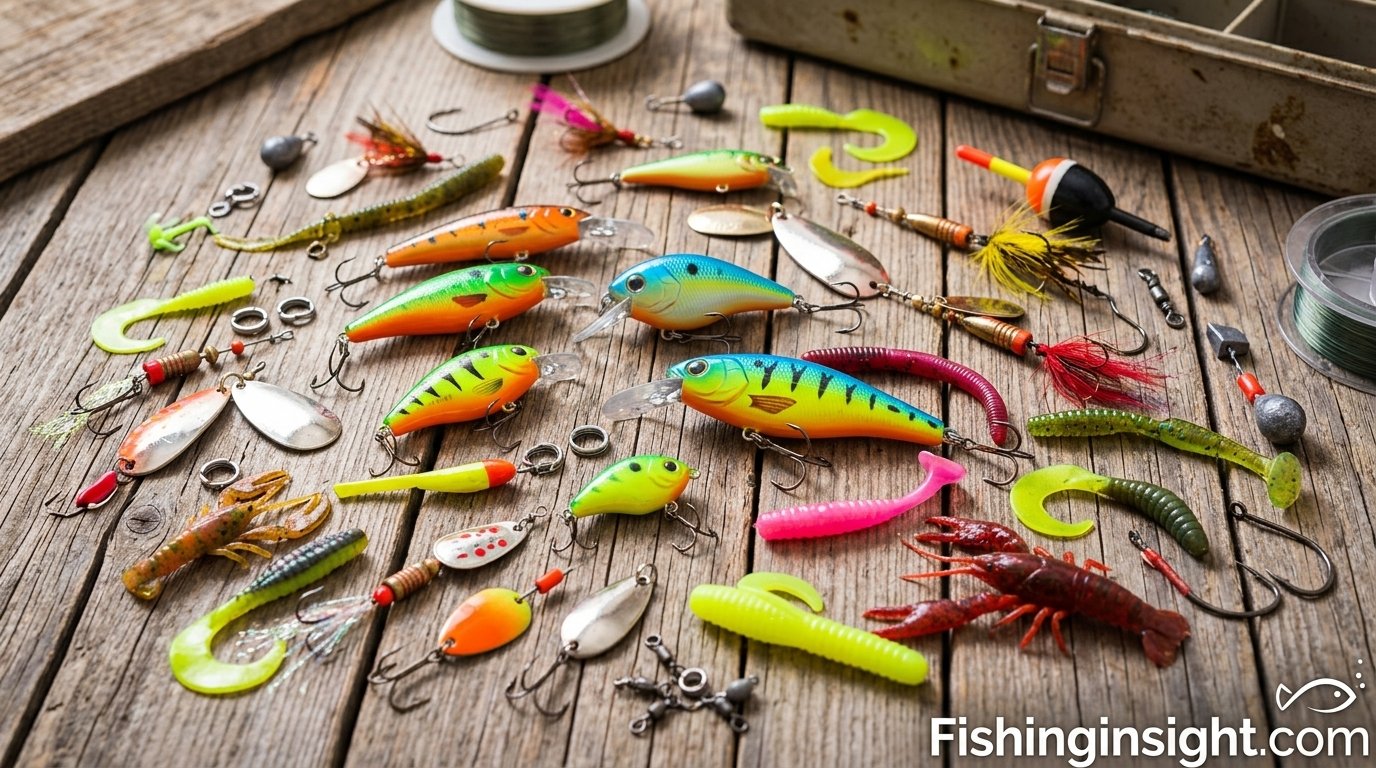
Soft Plastics: Soft plastic lures are among the most versatile and effective baits available. They come in an enormous variety of shapes, sizes, and colors, including worms, creature baits, crawfish imitations, swimbaits, grubs, and more. They can be rigged in countless ways — Texas rig, Carolina rig, drop shot, wacky rig, Ned rig — and can be fished at any depth and speed.
Hard Baits: Hard baits include crankbaits, jerkbaits, topwater lures, spinnerbaits, spoons, and jigs. Each type has a specific action and is designed to imitate a particular type of prey. A well-rounded collection might include a few shallow and deep-diving crankbaits, a suspending jerkbait, a couple of topwater lures (a popper and a walking bait), a few spinnerbaits in different weights, and an assortment of jigs.
Pliers and Line Cutters: A good pair of fishing pliers is indispensable. They are used for removing hooks from fish, crimping split shot, cutting line, and bending wire. Many fishing pliers include built-in line cutters, split-ring tools, and other features. A dedicated pair of line scissors or nippers is also useful for cutting braid and tippet.
Other Essentials: A small first-aid kit, sunscreen, insect repellent, a hat, polarized sunglasses, a tape measure, and a fish grip or lip gripper are all useful items to have in your tackle bag.

Plano 7771 Guide Series Tackle Box
Organize all your fishing gear in this spacious, well-designed tackle box. Features multiple compartments, removable trays, and durable construction.
Check Price on AmazonChoosing the Right Rod and Reel Combo
Selecting the right rod and reel combination is one of the most important decisions you will make as an angler. The right setup will feel like an extension of your arm — balanced, comfortable, and responsive. The wrong setup will feel awkward and hinder your ability to cast accurately, detect bites, and fight fish effectively.
For beginners, the best approach is to start with a pre-matched rod and reel combo. Many manufacturers offer combos that pair a rod and reel designed to work well together, taking the guesswork out of the selection process. These combos are available at every price point, from budget-friendly options under $30 to premium setups costing several hundred dollars.
When choosing a combo, consider the primary species you will be targeting and the techniques you will be using. If you plan to fish for bass, a medium-power spinning combo in the 6’6″ to 7′ range is an excellent starting point. If you are targeting panfish and trout, a light or ultra-light combo will provide more sensitivity and make fighting smaller fish more enjoyable. For catfish and other large freshwater species, a medium-heavy to heavy combo with greater line capacity is appropriate.
Balance is a critical factor that many beginners overlook. A well-balanced setup has the reel positioned so that the rod feels neutral in your hand — not tip-heavy or butt-heavy. An imbalanced setup causes fatigue during a long day of fishing and makes casting less efficient. When testing a combo in the store, hold the rod horizontally with your index finger on the rod just ahead of the reel. The rod should balance at or near that point.
As you gain experience, you may want to build custom setups by purchasing rods and reels separately. This allows you to fine-tune your equipment for specific techniques and conditions. For example, you might pair a fast-action, medium-heavy baitcasting rod with a high-speed reel for flipping jigs into heavy cover, or a moderate-action, medium-power spinning rod with a smooth-drag reel for fishing crankbaits.
| Target Species | Rod Power | Rod Length | Reel Type | Line Weight |
|---|---|---|---|---|
| Panfish / Trout | Ultra-light to Light | 5’6″ – 6’6″ | Spinning | 2 – 6 lb |
| Bass | Medium to Med-Heavy | 6’6″ – 7’6″ | Spinning or Baitcasting | 8 – 20 lb |
| Walleye | Medium-Light to Medium | 6′ – 7′ | Spinning | 6 – 12 lb |
| Northern Pike / Muskie | Medium-Heavy to Heavy | 7′ – 8′ | Baitcasting | 20 – 50 lb braid |
| Catfish | Medium-Heavy to Heavy | 7′ – 8′ | Spinning or Baitcasting | 15 – 30 lb |
| Redfish / Snook | Medium to Med-Heavy | 7′ – 7’6″ | Spinning | 10 – 20 lb braid |
| Salmon / Steelhead | Medium to Med-Heavy | 8’6″ – 10’6″ | Spinning or Centerpin | 10 – 20 lb |
Understanding the relationship between rod power, line weight, and lure weight is essential. Every rod is rated for a specific range of line weights and lure weights, which are printed on the blank near the handle. Using line or lures outside the recommended range will result in poor casting performance, reduced sensitivity, and an increased risk of rod breakage.
Reel size is equally important. Spinning reels are numbered from 1000 (smallest) to 10000+ (largest), though the numbering system varies slightly between manufacturers. For freshwater bass and walleye fishing, a 2500 or 3000 size reel is ideal. For panfish and trout, a 1000 or 2000 size is appropriate. For inshore saltwater fishing, a 3000 to 4000 size provides the line capacity and drag power needed for species like redfish and snook.
Do not overlook the importance of a quality reel. A smooth drag, reliable bail system, and durable construction are worth paying for. A cheap reel with a jerky drag will cost you fish, while a quality reel will perform flawlessly for years with minimal maintenance. Rinse your reel with fresh water after each use, especially after saltwater fishing, and lubricate the moving parts periodically according to the manufacturer’s recommendations.

Penn Battle III Spinning Reel
A rugged, full-metal spinning reel with smooth drag and incredible durability. Perfect for both freshwater and inshore saltwater fishing.
Check Price on AmazonFishing Techniques: Methods That Catch Fish
Mastering a variety of fishing techniques is the key to becoming a versatile and successful angler. Different situations call for different approaches, and the more techniques you have in your arsenal, the better equipped you will be to catch fish regardless of the conditions. Let us explore the most important techniques that every angler should know.
Casting
Casting is the fundamental skill that underpins all forms of fishing. The ability to place your lure or bait accurately and quietly at the desired distance is what separates productive anglers from those who spend their time untangling line and pulling lures out of trees.
Overhead Cast (Spinning): The basic overhead cast with a spinning reel is the first technique most anglers learn. Hold the rod with the reel below your hand, open the bail with your non-dominant hand, and hold the line against the rod with your index finger. Bring the rod back over your shoulder, then sweep it forward in a smooth motion, releasing the line with your finger at about the 10 o’clock position. The lure should fly toward your target in a smooth arc. Practice this motion until it becomes second nature.
Sidearm Cast: The sidearm cast is useful when you need to skip a lure under overhanging cover, such as docks, tree limbs, or boat houses. The motion is similar to skipping a stone across water. Keep the rod tip low and sweep it horizontally, releasing the line at a low angle. This cast takes practice but is incredibly effective for reaching fish in hard-to-reach spots.
Pitching: Pitching is a short-range, accurate casting technique used primarily in bass fishing. Hold the rod in your dominant hand and pull out enough line to reach your target (typically 15 to 30 feet). Hold the lure in your non-dominant hand, pull the rod tip back to load it, then release the lure and swing the rod forward simultaneously. The lure should land softly at the target. Pitching is ideal for presenting baits to visible targets like stumps, laydowns, and dock pilings.
Flipping: Flipping is an even shorter-range technique than pitching, used for fishing heavy cover at distances of 10 to 20 feet. Strip off a length of line equal to the distance you want to cast, hold the excess line in your non-dominant hand, and use a pendulum motion to swing the lure into the target. Flipping allows you to make repeated, accurate presentations to specific pieces of cover with minimal disturbance.
Roll Cast (Fly Fishing): The roll cast is an essential fly fishing technique used when there is not enough room behind you for a traditional backcast. Instead of casting the line behind you, you form a D-loop on the water’s surface and then drive the line forward with a sharp forward stroke. The roll cast is invaluable on small streams, in heavy brush, and whenever obstacles behind you prevent a backcast.
Trolling
Trolling is a technique where you drag lures or baited lines behind a slowly moving boat. It is one of the most effective methods for covering large areas of water and locating actively feeding fish. Trolling is used extensively in both freshwater and saltwater environments.
In freshwater, trolling is commonly used to target walleye, salmon, lake trout, and muskie. Anglers use a combination of diving lures, planer boards, downriggers, and lead-core line to present baits at specific depths. The key to successful trolling is maintaining a consistent speed (typically 1.5 to 3 mph for most freshwater species), presenting lures at the depth where fish are holding, and covering productive structure and contour changes.
Saltwater trolling is used to target pelagic species like tuna, mahi-mahi, wahoo, king mackerel, and billfish. Offshore trolling spreads typically include a combination of large lures, natural baits, and teasers arranged at varying distances behind the boat. Speeds range from 5 to 10 knots depending on the target species and lure type.
Modern trolling techniques incorporate sophisticated electronics, including GPS chartplotters that record trolling paths, sonar units that show fish depth and water temperature, and downriggers that allow precise depth control. However, the fundamental principle remains simple: put a lure in front of a hungry fish and let the boat do the work.
Jigging
Jigging is a versatile technique that involves imparting action to a weighted lure (jig) through vertical rod movements. Jigs are among the most effective lures ever created, and jigging techniques can be adapted to virtually any fishing situation.
Vertical Jigging: This technique is performed directly below the boat, making it ideal for fishing deep water, structure, and suspended fish. Drop the jig to the desired depth, then use sharp upward snaps of the rod tip to make the jig dart upward, followed by a controlled fall. Most strikes occur as the jig falls, so maintaining contact with the lure during the descent is critical.
Cast and Retrieve Jigging: Casting a jig and retrieving it with an erratic, jigging action is effective for covering water and triggering reaction strikes. This technique works well with swim jigs, football jigs, and hair jigs. Vary your retrieve speed and the intensity of your rod movements until you find what the fish want.
Ice Fishing Jigging: Jigging through the ice is the primary technique used by ice anglers. Small jigs and spoons are lowered through holes in the ice and worked with subtle movements. Because fish are less aggressive in cold water, ice fishing jigging often requires a more delicate touch — small twitches and long pauses can be the key to triggering strikes.
Bottom Fishing
Bottom fishing is a straightforward technique that targets fish feeding on or near the bottom. It is one of the most productive methods for catching a wide variety of species, including catfish, flounder, grouper, snapper, drum, and carp.
The basic setup involves a weight that holds the bait on the bottom and a hook presented near the weight. There are several popular bottom fishing rigs:
Carolina Rig: The Carolina rig consists of a sliding egg sinker on the main line, a bead, a swivel, a leader (typically 2 to 3 feet), and a hook with a soft plastic or live bait. The sliding sinker allows a fish to pick up the bait and move without immediately feeling the weight, resulting in more confident bites. The Carolina rig is excellent for fishing points, humps, and flats.
Drop Shot Rig: The drop shot rig places the hook above the weight, suspending the bait off the bottom. A Palomar knot is tied to the hook, and the tag end is left long and tied to a weight at the desired distance below the hook. This rig keeps the bait in the strike zone and allows the angler to shake the rod tip to impart subtle action to the bait without moving the weight. The drop shot is one of the most effective finesse techniques for pressured fish.
Fish Finder Rig: Popular in saltwater surf fishing, the fish finder rig uses a sliding sinker on the main line above a swivel, with a leader and hook below. The sliding design allows fish to take the bait without feeling resistance, and the heavy sinker holds the rig in place in the surf.

PLUSINNO 137-Piece Fishing Tackle Kit
Complete tackle kit with hooks, weights, swivels, snaps, and accessories. Everything you need to set up multiple rigs and techniques.
Check Price on AmazonPopular Fish Species to Target
One of the most exciting aspects of fishing is the incredible diversity of species available to anglers. Whether you fish in freshwater or saltwater, warm climates or cold, there is always a fascinating species to pursue. Understanding the habits, habitats, and preferences of different fish species will make you a more effective angler and deepen your appreciation for the aquatic world.
Largemouth Bass
The largemouth bass is arguably the most popular game fish in North America. Found in lakes, ponds, rivers, and reservoirs across the continent, largemouth bass are prized for their aggressive strikes, powerful fights, and the skill required to consistently catch them. They are ambush predators that prefer warm, weedy water with plenty of cover — submerged vegetation, fallen trees, docks, rocks, and other structure where they can hide and wait for prey to swim by.
Bass are opportunistic feeders that eat a wide variety of prey, including crayfish, shad, bluegill, frogs, insects, and even small mammals. This dietary flexibility means that a wide range of lures and techniques can be effective. Popular bass lures include plastic worms, crankbaits, spinnerbaits, jigs, topwater lures, and swimbaits. The best approach depends on the season, water temperature, clarity, and the mood of the fish.
Trout
Trout are among the most beautiful and sought-after freshwater fish. Several species are popular with anglers, including rainbow trout, brown trout, brook trout, and cutthroat trout. Trout are found in cold, clean streams, rivers, and lakes, and they are particularly associated with mountain environments and pristine wilderness areas.
Trout fishing has a rich tradition and is closely associated with fly fishing, though trout can also be caught effectively with spinning tackle and bait. In streams and rivers, trout hold in specific lies — areas where they can conserve energy while having access to food drifting by in the current. These lies include behind rocks, in the seams between fast and slow water, under overhanging banks, and in deep pools. Learning to read the water and identify productive lies is a fundamental skill for trout anglers.
Walleye
Walleye are prized for their excellent table fare and the challenge they present to anglers. These members of the perch family are found in lakes and rivers across the northern United States and Canada. Walleye are most active during low-light conditions — dawn, dusk, and nighttime — and they tend to relate to structure and depth transitions.
Walleye have excellent low-light vision due to a reflective layer in their eyes called the tapetum lucidum, which gives their eyes a distinctive glassy appearance. This adaptation allows them to feed effectively in dim conditions when their prey has difficulty seeing them. Successful walleye anglers take advantage of this behavior by fishing during prime low-light periods and using lures and techniques that appeal to walleye’s visual preferences.
Redfish (Red Drum)
Redfish are one of the most popular inshore saltwater species, found along the Atlantic and Gulf coasts of the United States. They are known for their copper-bronze coloration, distinctive black spot near the tail, and powerful, bulldog-like fight. Redfish inhabit shallow flats, marshes, oyster bars, and mangrove shorelines, and they are a favorite target of sight-fishing anglers.
Redfish are opportunistic feeders that eat crabs, shrimp, mullet, and other small fish. Popular lures include gold spoons, soft plastic jerkbaits, shrimp imitations, and topwater plugs. Live shrimp and cut mullet are also highly effective baits. Redfish can be caught year-round in many areas, but the best fishing often coincides with falling water temperatures in fall, when redfish school up and feed aggressively before winter.
Crappie
Crappie are among the most popular panfish in North America, and for good reason. They are abundant, relatively easy to catch, and delicious on the table. Two species exist — black crappie and white crappie — and both are found in lakes, reservoirs, ponds, and rivers across the country.
Crappie are schooling fish that tend to group together around structure, including submerged timber, brush piles, bridge pilings, and docks. They feed primarily on small minnows and insects and can be caught on small jigs, minnows, and tiny spinners. Spring is the prime season for crappie fishing, as they move into shallow water to spawn and feed aggressively. Vertical jigging over submerged structure is one of the most effective techniques.
| Species | Habitat | Best Season | Top Technique | Avg. Size |
|---|---|---|---|---|
| Largemouth Bass | Lakes, ponds, rivers | Spring – Fall | Soft plastics, crankbaits | 1 – 5 lbs |
| Rainbow Trout | Cold streams, rivers, lakes | Spring – Fall | Fly fishing, spinners | 0.5 – 3 lbs |
| Walleye | Lakes, rivers | Spring, Fall | Jigging, trolling | 1 – 4 lbs |
| Redfish | Coastal flats, estuaries | Year-round | Gold spoons, live bait | 3 – 10 lbs |
| Crappie | Lakes, ponds, rivers | Spring | Small jigs, minnows | 0.5 – 1.5 lbs |
| Catfish | Rivers, lakes, ponds | Summer | Bottom fishing, cut bait | 2 – 20 lbs |
| Northern Pike | Lakes, rivers | Spring, Fall | Spinnerbaits, spoons | 3 – 10 lbs |
| Smallmouth Bass | Rivers, rocky lakes | Spring – Fall | Ned rig, jerkbaits | 1 – 4 lbs |

Bassdash Multi-Species Lure Kit
Target multiple species with this comprehensive lure assortment. Includes crankbaits, spinners, jigs, and soft plastics for bass, trout, walleye, and more.
Check Price on AmazonFinding the Best Fishing Spots
One of the most common questions anglers ask is, “Where should I fish?” Finding productive fishing spots is part science, part art, and part experience. While there is no substitute for time on the water, understanding the principles that attract fish to certain areas will dramatically accelerate your learning curve.
Structure and Cover: The terms “structure” and “cover” are often used interchangeably, but they mean different things. Structure refers to changes in the bottom contour — points, humps, drop-offs, creek channels, ledges, and flats. Cover refers to objects in the water that provide hiding places for fish — submerged timber, vegetation, rocks, docks, boat lifts, and bridge pilings. Fish relate to both structure and cover, and the most productive spots often combine both elements.
Current and Flow: In rivers and streams, current is the primary factor that determines where fish position themselves. Fish face into the current, waiting for food to drift by. They hold behind rocks, in eddies, along current seams, and in deeper pools where they can conserve energy while staying close to the food supply. Understanding how current affects fish behavior is essential for river fishing success.
Water Temperature: Fish are cold-blooded creatures, and their behavior is heavily influenced by water temperature. Each species has an optimal temperature range in which it is most active and feeds most aggressively. Bass, for example, are most active in water temperatures between 65 and 85 degrees Fahrenheit. Trout prefer cooler water, with optimal temperatures between 50 and 65 degrees. Understanding these preferences helps you locate fish and choose appropriate techniques.
Water Clarity: The clarity of the water affects fish behavior and lure selection. In clear water, fish rely more on sight and tend to be more cautious. Use natural-colored lures, lighter line, and longer leaders. In stained or muddy water, fish rely more on their lateral line (which detects vibration) and sense of smell. Use brighter-colored lures, lures with rattles or vibration, and heavier line.
Using Technology: Modern technology has made finding fish easier than ever. A quality fish finder can reveal bottom structure, water depth, water temperature, and the presence of fish. GPS chartplotters allow you to mark productive spots and return to them precisely. Online resources, including fishing reports, lake maps, and social media groups, can provide valuable information about current conditions and productive areas. Learning how to use a fish finder effectively and understanding how to read a fish finder screen are skills that will dramatically improve your ability to locate fish.
Local Knowledge: Perhaps the most valuable resource for finding fishing spots is local knowledge. Bait shop owners, fishing guides, and experienced local anglers can point you in the right direction and save you countless hours of unproductive searching. Do not be afraid to ask questions — most anglers are happy to share general information about productive areas, even if they guard their exact spots.

Garmin Striker 4 Fish Finder
Find fish faster with this compact, easy-to-use fish finder. Features CHIRP sonar, GPS, and a clear 3.5-inch display. Read our full Garmin Striker 4 review.
Check Price on AmazonFishing for Beginners: Your First Day on the Water
If you have never been fishing before, the prospect of getting started can seem daunting. But it does not have to be. Fishing is one of the most beginner-friendly outdoor activities, and with a little preparation, your first day on the water can be enjoyable and productive. Here is everything you need to know to get started.
Getting Your License
Before you head to the water, you will need a fishing license. In the United States, anyone over the age of 16 is required to have a valid fishing license to fish in public waters. Licenses can be purchased online through your state’s fish and wildlife agency, at sporting goods stores, bait shops, and many other retail locations. Annual licenses are the most cost-effective option for regular anglers, but short-term licenses (1-day, 3-day, 7-day) are available for visitors and occasional anglers.
The money from fishing license sales funds conservation efforts, fish stocking programs, habitat restoration, and public access improvements. By purchasing a license, you are directly supporting the resource that makes fishing possible.
Choosing Your First Spot
For your first fishing trip, choose a location that is easily accessible and known to hold fish. Public fishing piers, community ponds, state park lakes, and well-stocked urban fishing ponds are all excellent choices. These locations are often designed with beginners in mind and may have amenities like restrooms, picnic areas, and fish cleaning stations.
Start simple. A small pond or lake with a population of bluegill, sunfish, or small bass is ideal. These species are abundant, relatively easy to catch, and will give you the opportunity to practice your casting, hook-setting, and fish-handling skills. Save the trophy bass lake or trout stream for after you have some experience under your belt.
What to Bring
Keep your gear simple for your first trip. Here is a basic checklist:
- A rod and reel combo (spinning or spincast, 6′ to 7′, medium power)
- Fishing line (6 to 10 lb monofilament, pre-spooled on the reel)
- A small assortment of hooks (sizes 6 to 1/0)
- Split shot sinkers
- Bobbers (floats)
- Bait (live worms, crickets, or small artificial lures)
- A small tackle box or bag
- Needle-nose pliers for hook removal
- A bucket or stringer for keeping fish (if desired)
- Sunscreen, hat, and polarized sunglasses
- Water and snacks
- Your fishing license
Basic Rig Setup
For your first outing, a simple bobber rig is hard to beat. Here is how to set it up:
Tie on a Hook
Start by tying a small hook (size 6 to 1/0) to the end of your line using an improved clinch knot. This is one of the most reliable and easy-to-tie fishing knots, and it works well for most freshwater applications.
Add a Split Shot
Pinch a small split shot sinker onto the line about 12 inches above the hook. This weight will help cast the rig and keep the bait at the desired depth. Use just enough weight to cast effectively — too much weight will make the rig feel unnatural to the fish.
Attach a Bobber
Clip a bobber onto the line 2 to 4 feet above the split shot, depending on the depth of the water you are fishing. The bobber serves two purposes: it suspends the bait at the desired depth, and it provides a visual indicator when a fish bites. Start with the bobber set shallow and adjust deeper if you are not getting bites.
Bait Your Hook
Thread a live worm onto the hook, covering as much of the hook as possible while leaving the point exposed. If using artificial bait, follow the package instructions for proper rigging. A small piece of worm or a single cricket is often more effective than a large wad of bait.
Cast and Wait
Hold the rod with the reel below your hand, open the bail, hold the line with your index finger, and cast toward a promising spot — near structure, vegetation, or shade. Close the bail, take up the slack line, and watch your bobber. When it goes under or moves sideways, set the hook with a firm upward snap of the rod.
Tips for Your First Trip
- Go early or late: Fish are most active during the cooler hours of dawn and dusk. Midday fishing, especially in summer, can be slow.
- Be patient: Fishing requires patience. Do not get discouraged if you do not catch a fish right away. Enjoy the experience of being outdoors.
- Keep it simple: Resist the urge to bring every piece of gear you own. A simple setup with live bait is often the most productive approach for beginners.
- Watch other anglers: Observe what other people at the same location are doing. What bait are they using? Where are they casting? Are they catching fish?
- Handle fish gently: If you plan to release your catch, wet your hands before handling the fish, avoid squeezing it, and return it to the water as quickly as possible.
- Have fun: The goal of your first trip is to have a good time. Catching fish is a bonus. Focus on learning, enjoying nature, and building positive memories.

Wakeman Fishing Rod and Reel Combo
Affordable and reliable starter combo perfect for beginners. Includes a 6’6″ spinning rod, pre-spooled reel, and a tackle kit to get you fishing right away.
Check Price on AmazonAdvanced Fishing Tips: Elevating Your Game
Once you have mastered the basics, it is time to take your fishing to the next level. Advanced anglers share certain habits and skills that consistently put them on fish. These tips will help you think more strategically, fish more efficiently, and catch more and bigger fish.
Pattern Fishing
Pattern fishing is the process of identifying a consistent set of conditions — depth, structure, cover, lure, presentation, and timing — that produce bites, and then replicating that pattern throughout the day. When you catch a fish, do not just celebrate and move on. Instead, analyze the catch: What depth was the fish at? What type of structure or cover was it relating to? What was the water temperature? What lure and technique produced the bite? Once you identify the pattern, you can systematically fish similar spots and dramatically increase your catch rate.
Seasonal Movements
Fish follow predictable seasonal patterns driven by water temperature, spawning behavior, and food availability. Understanding these patterns is one of the most important skills an angler can develop.
Pre-Spawn: As water temperatures rise in spring, fish move from their deep-water winter haunts toward shallow spawning areas. This is one of the best times to fish, as fish feed aggressively to build energy for the spawn. Focus on transitional areas between deep and shallow water — points, channel swings, and flats adjacent to spawning bays.
Spawn: During the spawn, many species move into very shallow water to build nests and reproduce. Bass, in particular, are visible on beds in clear water and can be targeted with sight-fishing techniques. However, many anglers choose to avoid targeting spawning fish to protect the resource.
Post-Spawn: After spawning, fish are often tired and hungry. They move to nearby cover and structure to recuperate and feed. This can be a challenging period because fish behavior can be unpredictable, but it can also produce some of the biggest fish of the year.
Summer: As water temperatures rise, fish seek comfortable temperatures and adequate oxygen levels. In lakes, this often means deeper water or areas with current and vegetation that produce oxygen. Early morning and late evening are the best times to fish, as fish move shallow to feed during low-light periods.
Fall: Falling water temperatures trigger a feeding frenzy as fish bulk up for winter. This is another prime time to fish, as fish are aggressive and willing to chase fast-moving lures. Focus on areas where baitfish congregate — creek channels, points, and flats near deep water.
Winter: Cold water slows fish metabolism, and they become lethargic and less willing to chase lures. Slow down your presentation, use smaller lures, and focus on deep water where temperatures are more stable.
Matching the Hatch
Fish are opportunistic feeders, but they tend to focus on the most abundant and available food source at any given time. Matching the hatch means selecting lures and baits that closely imitate what the fish are currently eating. Pay attention to the baitfish, insects, and crustaceans present in the water you are fishing, and choose lures that match their size, shape, color, and behavior.
Stealth and Presentation
Fish are remarkably sensitive to their environment. They can detect vibrations, shadows, and unnatural movements from a considerable distance. Stealth is especially important in shallow water, clear water, and when targeting pressured fish.
Approach fishing spots quietly, avoid making sudden movements, and keep your shadow off the water when possible. When casting, aim to place your lure as close to the target as possible with minimal splash. In fly fishing, a delicate presentation is often the difference between catching a fish and spooking it.
Reading the Water
Learning to read the water — to look at a body of water and understand where fish are likely to be — is one of the most valuable skills an angler can develop. Look for visual clues like current breaks, color changes, baitfish activity, bird activity, and surface disturbances. Subtle features that might escape the untrained eye — a slight change in water color, a barely visible current seam, a cluster of baitfish dimpling the surface — can be the key to finding fish.
Keeping a Fishing Log
One of the best habits you can develop as an angler is keeping a detailed fishing log. Record the date, location, weather conditions, water temperature, water clarity, wind direction, barometric pressure, the techniques you used, the lures you threw, and the fish you caught (species, size, depth, location). Over time, this log becomes an invaluable resource that reveals patterns and helps you make better decisions on the water.

TRUSCEND Multi-Jointed Swimbaits
Life-like swimbaits that perfectly match the hatch. Multi-jointed design creates a realistic swimming action that triggers reaction strikes from trophy fish.
Check Price on AmazonFishing Safety: Protecting Yourself on the Water
Fishing is generally a safe activity, but like any outdoor pursuit, it comes with certain risks. Being prepared and aware of potential hazards will help you enjoy your time on the water safely.
Sun Protection
Extended sun exposure is one of the most common health risks for anglers. Water reflects UV rays, intensifying your exposure. Always wear a broad-spectrum sunscreen (SPF 30 or higher), reapply every two hours, wear a wide-brimmed hat, and invest in a quality pair of polarized sunglasses that protect against UV rays. Lightweight, long-sleeved sun shirts provide excellent protection without causing overheating.
Hydration and Heat Safety
Dehydration and heat-related illness are serious risks, especially during summer fishing. Bring plenty of water — more than you think you will need — and drink regularly throughout the day, even if you do not feel thirsty. Symptoms of heat exhaustion include heavy sweating, weakness, nausea, dizziness, and headache. If you experience these symptoms, move to a cool area, drink water, and seek medical attention if symptoms persist.
Hook Safety
Fishing hooks are sharp, and hook injuries are among the most common fishing-related injuries. Always be aware of where your hook is, especially when casting near other people. If you do get hooked, do not attempt to pull the hook out if it is embedded deeply. Push the hook through until the barb exits, cut the barb off, and then back the hook out. Seek medical attention for deep or infected wounds.
Water Safety
Drowning is a real risk for anglers, particularly those fishing from boats, kayaks, or wading in rivers. Always wear a properly fitted personal flotation device (PFD) when on the water. This is especially important for children, non-swimmers, and anyone fishing in cold water, strong currents, or rough conditions. In many states, wearing a PFD is legally required in certain situations.
When wading in rivers, use a wading belt to prevent your waders from filling with water if you fall in. Use a wading staff for stability, and never wade in water that is deeper than your comfort level or faster than you can safely navigate. Felt-soled or studded wading boots provide traction on slippery rocks.
Weather Awareness
Weather conditions can change rapidly on the water, and being caught in a storm can be dangerous. Check the weather forecast before every fishing trip and monitor conditions throughout the day. If you see darkening skies, increasing wind, or hear thunder, head for shore immediately. Lightning is a serious threat to anglers, especially those on open water or holding graphite rods. The general rule is: if you can hear thunder, you are close enough to be struck by lightning.
Wildlife Encounters
Depending on where you fish, you may encounter wildlife that warrants caution. Alligators are present in many southern waterways and should always be given a wide berth. Snakes, including venomous species, are common along shorelines and in vegetation. Bears, moose, and other large animals may be encountered in northern and wilderness areas. Be aware of your surroundings, make noise to alert animals to your presence, and never approach or feed wildlife.
Essential Safety Gear: Always carry a first-aid kit, whistle, flashlight, waterproof phone case, and a charged cell phone when fishing. Let someone know where you are going and when you plan to return. These simple precautions can be lifesaving in an emergency.

Onyx MoveVent Dynamic PFD
Stay safe on the water with this comfortable, Coast Guard-approved life vest. Designed for anglers with mesh ventilation and multiple adjustment points.
Check Price on AmazonCatch and Release Best Practices
Catch and release is a conservation practice that allows anglers to enjoy the thrill of catching fish while preserving fish populations for future generations. When done correctly, catch and release has a very high survival rate — studies have shown that properly handled fish have survival rates of 90% or higher. However, improper handling can significantly reduce survival. Here are the best practices for responsible catch and release.
Use the Right Tackle
Match your tackle to the size of fish you are targeting. Using tackle that is too light prolongs the fight, exhausting the fish and reducing its chances of survival. Use circle hooks when fishing with natural bait — they are designed to hook fish in the corner of the mouth rather than deep in the throat, making hook removal easier and less damaging.
Minimize Fight Time
Land the fish as quickly as possible. A prolonged fight depletes the fish’s energy reserves and causes a buildup of lactic acid in its muscles, which can be fatal. Use appropriately heavy tackle and apply steady pressure to bring the fish in efficiently.
Handle with Care
Wet your hands before handling the fish. Dry hands remove the protective slime coat that shields fish from infection. Never grip a fish by the eyes or gills. For bass and other species that can be held by the lip, use a lip grip or your thumb (for bass) to control the fish. For trout and other delicate species, cradle the fish gently with one hand under the belly and the other near the tail.
Remove Hooks Quickly
Use needle-nose pliers or a hook remover to extract the hook as quickly as possible. If the hook is deeply embedded, cut the line as close to the hook as possible rather than trying to dig it out. Many fish will survive with a hook that eventually rusts away.
Revive Before Release
If the fish appears lethargic after being caught, hold it upright in the water with your hand gently gripping the tail. Move the fish back and forth slowly to force water over its gills. Once the fish shows signs of strength — it will try to swim away — release it gently. Do not throw or drop the fish back into the water.
Photograph Responsibly
If you want a photo of your catch, keep the fish in the water until you are ready, have your camera set up in advance, lift the fish briefly for the photo, and return it to the water immediately. Limit air exposure to a few seconds at most. Every second a fish is out of water reduces its chances of survival.

Fish Grip Lip Gripper with Scale
Safely handle and weigh your catch without damaging the fish. Features a built-in scale, quick-release mechanism, and lanyard for security.
Check Price on AmazonFishing Regulations and Licensing
Fishing regulations exist to protect fish populations and ensure sustainable fishing for future generations. Understanding and following these regulations is both a legal requirement and an ethical responsibility for every angler.
Why Regulations Matter
Fish populations are a shared natural resource, and without management, they can be depleted by overfishing, habitat loss, and environmental changes. Fishing regulations — including size limits, bag limits, seasonal closures, and gear restrictions — are designed to maintain healthy fish populations while allowing recreational fishing to continue.
These regulations are based on scientific research and population assessments conducted by state and federal fisheries biologists. They are regularly updated to reflect current conditions and are tailored to the specific needs of each water body and species.
Common Regulations
Bag Limits: A bag limit is the maximum number of fish of a particular species that an angler can keep per day. Bag limits vary by species and location. For example, the daily bag limit for largemouth bass might be 5 fish, while the limit for walleye might be 4. Some waters have reduced or increased limits based on the health of the fishery.
Size Limits: Size limits specify the minimum (and sometimes maximum) length of fish that can be legally kept. Minimum size limits protect juvenile fish and allow them to reach spawning age before being harvested. Slot limits protect a specific size range — for example, a slot limit might require anglers to release all bass between 14 and 18 inches, keeping only fish outside that range.
Seasonal Closures: Some waters are closed to fishing during specific times of the year, typically during spawning seasons, to protect vulnerable fish populations. These closures are especially common for trout streams and salmon rivers.
Gear Restrictions: Regulations may restrict the type of gear that can be used in certain waters. Common restrictions include limits on the number of hooks, prohibitions on certain types of bait (such as live bait in some trout streams), and restrictions on the use of nets, traps, or other harvest methods.
How to Stay Informed
Fishing regulations change frequently, so it is important to check the current rules before every fishing trip. Your state’s fish and wildlife agency website is the most reliable source of information. Many states also publish a fishing regulation booklet that is available at license vendors and online. When in doubt, contact your local fish and wildlife office for clarification.
Remember that ignorance of the law is not a valid defense. Conservation officers regularly check anglers for compliance, and violations can result in fines, equipment confiscation, and even loss of fishing privileges. More importantly, following regulations is the right thing to do — it ensures that the fish populations you enjoy today will be there for your children and grandchildren to enjoy tomorrow.

Recreational Fishing Regulations Guide
Stay up to date with the latest fishing regulations. Check your state’s fish and wildlife website for current rules, bag limits, and size limits before every trip.
Find Your State’s RegulationsFish Finders and Electronics: Technology on the Water
Modern fishing electronics have revolutionized the way anglers find and catch fish. A quality fish finder can reveal underwater structure, locate fish, measure water temperature, and record your position — all in real time. Understanding how to use these tools effectively can dramatically improve your fishing success.
How Fish Finders Work
Fish finders use sonar (Sound Navigation and Ranging) technology to detect objects underwater. A transducer mounted on the boat’s hull or trolling motor sends sound waves into the water. When these waves hit an object — the bottom, a fish, a school of baitfish, or structure — they bounce back to the transducer. The fish finder’s computer processes these returning signals and displays them on a screen as a visual representation of what is below the boat.
Learning how to read a fish finder is an essential skill for modern anglers. The display shows the bottom contour, depth, water temperature, and — most importantly — the presence of fish. Fish typically appear as arches or icons on the screen, depending on the display mode. Understanding what you are seeing on the screen takes practice, but it is a skill that will pay dividends for the rest of your fishing career.
Types of Sonar
Traditional Sonar: Traditional sonar uses a single frequency to send a cone-shaped beam straight down. It provides a real-time view of what is directly below the boat. Traditional sonar is effective for general fish finding and bottom contour mapping.
CHIRP Sonar: CHIRP (Compressed High-Intensity Radiated Pulse) sonar sends a sweep of frequencies rather than a single frequency. This produces a much clearer, more detailed image with better target separation. CHIRP sonar can distinguish individual fish in a school and provide more accurate bottom readings. Most modern fish finders include CHIRP technology.
Down Imaging: Down imaging (also called DownScan) uses a thin, fan-shaped beam to create a photographic-quality image of the bottom and structure directly below the boat. It shows detailed images of submerged timber, rocks, vegetation, and other structure, making it easier to identify fish-holding cover.
Side Imaging: Side imaging (SideScan) sends sonar beams to both sides of the boat, creating detailed images of the bottom structure to the left and right. This allows you to scan large areas of water without driving over them, making it much faster to locate structure, cover, and fish. Side imaging is particularly effective for finding submerged points, humps, creek channels, and other structure that would be invisible with traditional sonar alone.
Live Sonar: Live sonar (such as Garmin LiveScope and Lowrance ActiveTarget) provides a real-time, forward-facing view of what is happening in front of or around the boat. You can watch fish swim, see your lure’s movement, and observe fish reacting to your presentation in real time. Live sonar has been a game-changer for many anglers, particularly in tournament fishing.
Choosing a Fish Finder
When selecting a fish finder, consider the following factors:
- Screen Size: Larger screens (7 inches and up) are easier to read and can display more information simultaneously. Smaller screens (3.5 to 5 inches) are more portable and affordable.
- Resolution: Higher resolution screens produce sharper, clearer images. Look for screens with at least 800×480 pixels.
- Sonar Type: CHIRP sonar is a must-have feature. Down imaging and side imaging are valuable additions that significantly improve your ability to find fish and structure.
- GPS: Built-in GPS allows you to mark productive spots, create routes, and view charts. This is an essential feature for any serious angler.
- Maps: Many fish finders come preloaded with detailed lake and coastal maps. Some models allow you to create your own custom maps using sonar data.
For a detailed comparison of the top models on the market, check out our guide to the best fish finders. If you are looking for specific reviews, we have in-depth coverage of the Garmin Striker 4, the Lowrance Hook Reveal, and the Humminbird HELIX series.
| Feature | Garmin Striker 4 | Lowrance Hook Reveal | Humminbird HELIX 5 |
|---|---|---|---|
| Screen Size | 3.5″ | 5″ / 7″ / 9″ | 5″ |
| CHIRP Sonar | Yes | Yes | Yes |
| Down Imaging | No | Yes | Yes |
| Side Imaging | No | Optional | No |
| GPS | Yes | Yes | Yes |
| Maps | Basic | C-MAP / US Inland | UniChart |
| Best For | Budget / Beginners | Mid-range / All-around | Entry-level / Freshwater |
Garmin Striker 4 Fish Finder
The best-selling entry-level fish finder. CHIRP sonar, GPS, and waypoint marking in a compact, affordable package. Read our full review.
Check Price on AmazonFishing Boats and Kayaks: Getting on the Water
While shore fishing is accessible and productive, having a boat or kayak opens up a world of possibilities. A watercraft allows you to reach fish that are inaccessible from shore, cover more water, fish deeper, and access remote locations. The type of watercraft you choose depends on your budget, the waters you fish, and your personal preferences.
Fishing Kayaks
Fishing kayaks have exploded in popularity in recent years, and for good reason. They are affordable, portable, low-maintenance, and provide access to waters that larger boats cannot reach. Modern fishing kayaks are designed specifically for angling, with features like rod holders, tackle storage, fish finder mounts, and stable platforms for standing and casting.
There are two main types of fishing kayaks: sit-on-top and sit-inside. Sit-on-top kayaks are the most popular choice for fishing because they are stable, easy to get in and out of, self-draining, and provide more room for gear. Sit-inside kayaks offer better protection from the elements and are more efficient to paddle, but they are less stable and more difficult to re-enter if you capsize.
Pedal-driven kayaks have become increasingly popular among serious kayak anglers. These kayaks use a pedal-powered propeller or fin system that allows you to move the kayak with your feet, freeing your hands for fishing. They are faster and more efficient than paddle-driven kayaks, but they are heavier and more expensive.
Bass Boats
Bass boats are the gold standard for freshwater bass fishing. These low-profile, high-performance boats are designed for speed, stability, and functionality. They feature powerful outboard motors for quick runs between fishing spots, trolling motors for precise boat control, live wells for keeping fish alive, rod storage, and large casting decks at the bow and stern.
Bass boats range from 16 to 21 feet in length and can be powered by outboard motors ranging from 50 to 300 horsepower. They are typically trailered and require a vehicle capable of towing them. While bass boats represent a significant investment, they are the tool of choice for tournament anglers and serious bass fishermen.
Aluminum Fishing Boats
Aluminum boats are a versatile and affordable option for freshwater fishing. They come in a variety of configurations, from small jon boats and utility boats to larger deep-V models designed for big water. Aluminum boats are lightweight, durable, and easy to maintain. They can be powered by small outboard motors and are easily trailered and launched at public boat ramps.
Pontoon Boats
Pontoon boats offer a stable, comfortable platform that is ideal for family fishing outings and relaxed days on the water. Their wide, flat decks provide plenty of room for multiple anglers, and their stability makes them an excellent choice for those who are uncomfortable on smaller, less stable boats. Many pontoon boats are equipped with fishing-specific features like rod holders, live wells, and fish finder mounts.
Choosing the Right Watercraft
When choosing a fishing watercraft, consider the following:
- Budget: Fishing kayaks start under $300, while bass boats can cost $30,000 or more. Determine what you can afford before shopping.
- Storage and Transport: Do you have space to store a boat? Do you have a vehicle that can tow it? Kayaks can be stored in a garage and transported on a car roof rack.
- Fishing Style: If you fish small rivers and ponds, a kayak may be ideal. If you fish large lakes and need to cover long distances quickly, a bass boat is more appropriate.
- Maintenance: Boats require regular maintenance — engine service, hull cleaning, battery charging, and winterization. Kayaks require minimal maintenance.

YakAttack Kayak Fishing Gear Track Kit
Outfit your kayak for serious fishing with this versatile gear track system. Mount rod holders, fish finders, and accessories exactly where you want them.
Check Price on AmazonSeasonal Fishing Strategies: Fishing Year-Round
One of the great things about fishing is that it can be enjoyed year-round. Each season brings unique conditions, challenges, and opportunities. Understanding how fish behavior changes with the seasons will help you adapt your approach and stay productive no matter what the calendar says.
Spring Fishing
Spring is a time of transition and renewal in the fishing world. As water temperatures rise from their winter lows, fish become increasingly active and begin moving toward shallow water. Early spring can be challenging because fish are still in a transitional pattern — they may be deep one day and shallow the next, depending on weather conditions.
The key to spring fishing is monitoring water temperature. When water temperatures reach the mid-50s for bass, the mid-40s for walleye, and the upper 40s for crappie, fish begin their pre-spawn migration toward shallow water. Focus on areas where shallow and deep water meet — points, channel swings, and flats near spawning bays. Suspending jerkbaits, lipless crankbaits, and jigs are all effective spring lures.
As water temperatures continue to rise into the 60s, spawning activity begins. Many species move into very shallow water to build nests and reproduce. This can be an excellent time to catch fish, but it is also a time to practice restraint and release spawning fish whenever possible.
Summer Fishing
Summer presents both opportunities and challenges for anglers. Warm water temperatures increase fish metabolism, meaning they need to eat more frequently. However, extreme heat can push fish deep or into heavy cover where oxygen levels are higher.
The best summer fishing typically occurs during low-light periods — early morning, late evening, and at night. During the heat of the day, focus on deep structure, shaded cover, and areas with current or vegetation. Topwater lures are incredibly effective during dawn and dusk, when fish are actively feeding in shallow water. During midday, switch to deep-diving crankbaits, Carolina rigs, drop shots, and other techniques that reach fish in deeper water.
Summer is also prime time for night fishing. Many species, including bass, catfish, and walleye, are more active at night during the summer months. Use dark-colored lures that create a silhouette against the night sky, and fish slowly and deliberately.
Fall Fishing
Fall is widely regarded as the best season for fishing, and for good reason. As water temperatures begin to drop, fish enter a feeding frenzy, bulking up for the long winter ahead. They become aggressive, willing to chase fast-moving lovers, and often feed in large schools.
The key to fall fishing is following the baitfish. As water cools, baitfish (shad, minnows, herring) begin migrating from shallow to deep water. Predatory fish follow them, creating concentrations of activity along migration routes. Points, creek channels, and flats near deep water are prime fall fishing locations.
Fall is an excellent time for reaction baits — spinnerbaits, crankbaits, jerkbaits, and lipless crankbaits. The aggressive nature of fall fish means they are more likely to strike fast-moving lures. As water temperatures drop further into the 50s and 40s, slow down your presentation and switch to jigs, blade baits, and other slower-moving lures.
Winter Fishing
Winter fishing can be challenging, but it can also be incredibly rewarding. Cold water slows fish metabolism, making them lethargic and less willing to chase lures. The key to winter fishing is slowing down, fishing deep, and being patient.
In southern regions where ice does not form, winter fishing can be excellent. Fish concentrate in deeper water near the warmest available temperatures, and they feed in short, predictable bursts. Small jigs, blade baits, and drop shots fished slowly near the bottom are effective winter techniques.
In northern regions, ice fishing takes over as the primary form of angling. Ice fishing requires specialized equipment and safety precautions, but it can be incredibly productive. Panfish, walleye, pike, and lake trout are all popular ice fishing targets.
| Season | Water Temp | Fish Behavior | Top Techniques | Best Lures |
|---|---|---|---|---|
| Spring | 45 – 65°F | Pre-spawn migration, aggressive feeding | Jigging, jerkbaits | Lipless crankbaits, jigs |
| Summer | 70 – 85°F | Deep or shaded, low-light feeders | Topwater, deep cranks | Topwater, worms, drop shot |
| Fall | 50 – 70°F | Aggressive feeding, schooling | Reaction baits, crankbaits | Spinnerbaits, jerkbaits |
| Winter | 33 – 45°F | Lethargic, deep, slow feeding | Slow finesse, ice fishing | Blade baits, small jigs |

Complete Seasonal Lure Collection
Be prepared for any season with this comprehensive lure kit. Includes topwater baits, crankbaits, jigs, and soft plastics for year-round fishing success.
Check Price on AmazonEssential Fishing Knots Every Angler Should Know
A fishing knot is the weakest link in your tackle system. A poorly tied knot can fail at the worst possible moment — when you are fighting the fish of a lifetime. Learning to tie a few reliable knots quickly and confidently is one of the most important skills any angler can develop.
Improved Clinch Knot
The improved clinch knot is one of the most widely used fishing knots. It is easy to tie, reliable, and works well for attaching hooks, lures, and swivels to monofilament and fluorocarbon line. To tie it, thread the line through the eye of the hook, wrap the tag end around the standing line 5 to 7 times, thread the tag end through the small loop near the hook eye, then back through the large loop you just created. Moisten the knot and pull it tight.
Palomar Knot
The Palomar knot is considered by many to be the strongest fishing knot. It retains nearly 100% of the line’s rated strength and is easy to tie. Double the line, pass the loop through the hook eye, tie an overhand knot with the doubled line, pass the hook through the loop, and pull both ends to tighten. The Palomar knot works well with all line types and is the recommended knot for braided line.
Uni Knot
The uni knot (also called the Duncan loop) is one of the most versatile fishing knots. It can be used to attach hooks and lures, create a loop for lure action, and join two lines together (double uni knot). To tie a uni knot, pass the line through the hook eye, make a loop with the tag end, wrap the tag end around both lines and through the loop 5 to 7 times, and pull tight.
Loop Knot
A loop knot attaches a lure to the line with a small loop that allows the lure to move freely. This is important for lures that rely on their natural action — jerkbaits, topwater lures, and jigs all benefit from a loop knot attachment. The non-slip mono loop knot is one of the most popular loop knots and is easy to tie.
Line-to-Line Connections
Connecting two lines — such as attaching a fluorocarbon leader to braided main line — requires a reliable line-to-line knot. The double uni knot and the FG knot are two of the most popular options. The double uni knot is easier to tie and works well for most applications. The FG knot is more difficult to tie but creates a slimmer, stronger connection that passes through rod guides more easily.
Knot-Tying Tip: Always moisten your knot with saliva or water before pulling it tight. This reduces friction and heat, which can weaken the line. After tightening, trim the tag end close to the knot, leaving about 1/8 inch to prevent slippage.

Tie-Fast Knot Tyer Tool
Tie perfect knots every time with this easy-to-use knot tool. Works with all line types and helps you tie clinch knots, loop knots, and more in seconds.
Check Price on AmazonFishing Boots and Wading Gear: Staying Comfortable and Safe
Proper footwear and wading gear are essential for many types of fishing, particularly fly fishing, stream fishing, and surf fishing. The right boots and waders keep you comfortable, protect you from the elements, and provide the traction you need to navigate slippery river bottoms and rocky shorelines safely.
Wading Boots
Wading boots are specialized footwear designed for fishing in and around water. They feature reinforced construction, quick-draining designs, and aggressive outsoles for traction on wet rocks and slippery surfaces. The two main types of outsoles are felt and rubber.
Felt-soled boots provide excellent traction on algae-covered rocks and have long been the standard for freshwater wading. However, felt soles have come under scrutiny because they can transport invasive species between waterways. Many states have banned felt-soled boots, so check your local regulations before purchasing.
Rubber-soled boots with tungsten carbide studs are the modern alternative to felt. They provide excellent traction on most surfaces, are easier to clean and dry, and do not transport invasive organisms. Some rubber-soled boots also feature interchangeable sole systems that allow you to switch between felt, rubber, and studded soles depending on the conditions.
When choosing wading boots, look for a comfortable fit that accommodates neoprene stockingfoot waders. The boots should be snug enough to provide support but roomy enough to allow for thick socks and wader feet. Quality wading boots from brands like Simms, Orvis, Korkers, and Chota are built to last and provide the support and traction you need for a full day on the water. For detailed reviews, check out our guides to the best fishing boots, Orvis wading boots, Frogg Toggs boots, and Compass 360 boots.
Waders
Waders are waterproof garments that allow you to wade into water while staying dry. They come in three main styles: hip waders, waist-high waders, and chest waders. Chest waders are the most versatile and popular choice, as they allow you to wade into deeper water and provide protection from rain and spray.
Waders are made from three primary materials: neoprene, breathable fabric (such as Gore-Tex), and rubber. Neoprene waders are warm and durable, making them ideal for cold-water fishing and winter use. Breathable waders are lightweight, comfortable, and suitable for a wide range of temperatures. They are the most popular choice for warm-weather fishing. Rubber waders are the most affordable option but are heavy, stiff, and not breathable.
Stockingfoot waders have neoprene feet and are worn with separate wading boots. This combination provides better fit, support, and traction than bootfoot waders, which have boots permanently attached. Most serious anglers prefer stockingfoot waders with quality wading boots.
Wading Safety
Wading in rivers and streams requires caution and awareness. Always use a wading belt to prevent water from filling your waders if you fall in. A wading staff provides stability and can help you probe the depth of the water ahead of you. Felt-soled or studded boots are essential for traction on slippery rocks. Never wade in water that is deeper than your comfort level, faster than you can safely navigate, or in conditions you are unfamiliar with.

Frogg Toggs Hellbender Wading Boots
Lightweight, durable wading boots with excellent traction. Features a reinforced toe cap, padded collar, and quick-drain design. Read our full Frogg Toggs review.
Check Price on AmazonFishing with Kids: Creating Lifelong Anglers
Introducing children to fishing is one of the greatest gifts you can give them. Fishing teaches patience, respect for nature, problem-solving skills, and provides quality time away from screens. Many of the fondest childhood memories involve fishing with a parent, grandparent, or mentor. Here is how to make fishing with kids a positive and successful experience.
Keep It Simple
Children have short attention spans, so keep the experience simple and action-oriented. Use a basic bobber rig with live bait — worms are the universal fish attractor. Target species that are easy to catch and abundant, such as bluegill, sunfish, and perch. The goal is to keep the kids engaged with frequent bites and catches, not to pursue trophy fish that require hours of patience.
Choose the Right Location
Select a fishing spot that is safe, accessible, and productive. Stocked ponds, community fishing piers, and small lakes with abundant panfish are ideal. Look for locations with amenities like restrooms, picnic tables, and shade. Avoid spots with steep banks, deep water near shore, or heavy boat traffic.
Use Kid-Friendly Gear
Choose a rod and reel that is sized for a child’s hands. Spincast reels are the easiest for young children to use, as they require only a push of a button to cast. Short rods (4 to 5 feet) are easier for kids to handle than longer rods. Many manufacturers make rod and reel combos specifically designed for children, often featuring popular cartoon characters or bright colors.
Teach, Do Not Just Fish
Use fishing as an opportunity to teach children about nature, ecology, and responsibility. Show them how to bait a hook, tie a knot, and cast a line. Explain why fish live where they do and what they eat. Teach them about conservation and the importance of releasing fish gently. These lessons extend far beyond fishing and help children develop a deeper connection to the natural world.
Celebrate the Experience
Make fishing fun, not just educational. Celebrate every catch, no matter how small. Take photos, let the kids hold the fish (with supervision), and make a big deal out of their accomplishments. Bring snacks, drinks, and other activities (like exploring the shoreline for frogs and crayfish) to keep kids engaged during slow periods.
Know When to Quit
Pay attention to the kids’ energy and interest levels. When they start getting restless, bored, or uncomfortable, it is time to pack up — even if the fishing is good. Ending on a positive note ensures that kids will want to come back. Pushing them to stay longer when they are done will create negative associations with fishing.
Pro Tip: Start with short fishing trips — 30 minutes to an hour for young children. You can gradually extend the duration as their interest and attention span grow. It is better to have a short, fun trip than a long, frustrating one.

Kids Fishing Rod and Reel Combo
The perfect starter kit for young anglers. Features a tangle-free spincast reel, short rod, and colorful design that kids love. Includes a tackle box with starter lures.
Check Price on AmazonFishing Gear Maintenance: Making Your Equipment Last
Quality fishing gear is an investment, and like any investment, it pays to take care of it. Proper maintenance extends the life of your equipment, ensures optimal performance, and prevents frustrating equipment failures at critical moments. A little maintenance goes a long way.
Rod Care
After each fishing trip, rinse your rod with fresh water to remove salt, dirt, and debris. Pay special attention to the guides (the metal rings that direct the line), as salt and grit can accumulate and damage both the guides and your line. Inspect the guides periodically for cracks, grooves, or rough spots — a damaged guide can cut your line at the worst possible moment. Store rods vertically in a rod rack or horizontally in a rod tube to prevent warping and damage.
Reel Maintenance
Reels require the most maintenance of any fishing equipment. After each use, especially in saltwater, rinse the reel gently with fresh water. Avoid directing a strong stream of water into the reel’s internals, as this can force salt and debris deeper into the mechanism. After rinsing, wipe the reel dry and apply a light coat of reel oil to the handle knobs, bail arm, and line roller.
Once or twice per season, perform a more thorough reel maintenance. Remove the spool, clean the drag washers, and apply fresh drag grease. Lubricate the gears and bearings with reel oil. Inspect the bail spring, line roller, and anti-reverse mechanism for wear. If you are not comfortable performing this maintenance yourself, many tackle shops offer reel servicing.
Line Care
Monofilament and fluorocarbon line degrade over time with UV exposure, abrasion, and use. Replace your line at least once per season, or more frequently if you fish heavily or notice line damage (nicks, memory coils, discoloration). Braided line lasts longer but should be replaced when it becomes frayed or discolored.
To extend the life of your line, store your reels in a cool, dark place when not in use. Avoid leaving rods and reels in direct sunlight or in a hot car for extended periods. After fishing in saltwater, rinse the entire spool with fresh water and allow it to dry completely before storing.
Lure and Hook Care
After each trip, rinse your lures and hooks with fresh water and dry them before returning them to your tackle box. Sharpen hooks regularly with a hook file — a sharp hook penetrates more easily and results in better hooksets. Replace rusty or damaged hooks immediately. Organize your tackle box regularly, discarding damaged lures and replacing used soft plastics.
Wader and Boot Care
After each use, rinse your waders and boots with fresh water and allow them to dry completely before storing. Hang waders to dry in a well-ventilated area, avoiding direct sunlight and heat sources. Store waders loosely folded or hanging — never compressed in a tight space. Inspect waders regularly for leaks and repair small punctures with wader repair patches.

Abu Garcia Reel Maintenance Kit
Keep your reels in top condition with this complete maintenance kit. Includes reel oil, grease, cleaning tools, and detailed instructions for all reel types.
Check Price on AmazonFishing as a Lifestyle: More Than Just a Hobby
For millions of people around the world, fishing is more than just a hobby — it is a way of life. It shapes how they spend their weekends, where they choose to live, who they spend time with, and how they think about the natural world. The fishing lifestyle encompasses a rich culture of traditions, stories, conservation ethics, and community.
The Mental Health Benefits of Fishing
In an increasingly fast-paced and digital world, fishing offers a rare opportunity to slow down, disconnect, and reconnect with nature. The rhythmic motion of casting, the sound of water flowing over rocks, the anticipation of a bite — these experiences have a meditative quality that reduces stress and promotes mental well-being.
Research has shown that spending time in nature reduces cortisol levels, lowers blood pressure, and improves mood. Fishing combines the benefits of nature exposure with physical activity, social connection, and the satisfaction of learning and mastering a skill. Many anglers describe fishing as their primary form of stress relief and mental health maintenance.
Fishing has also been used therapeutically for veterans, people recovering from addiction, and individuals dealing with mental health challenges. Organizations like Project Healing Waters Fly Fishing and Casting for Recovery use fishing as a tool for healing and personal growth.
The Fishing Community
One of the most rewarding aspects of the fishing lifestyle is the community. Anglers are bound together by a shared passion, and the fishing community is remarkably welcoming and supportive. Local fishing clubs, online forums, social media groups, and tournament circuits provide opportunities to connect with fellow anglers, share knowledge, and build lasting friendships.
Fishing also strengthens family bonds. Some of the most meaningful conversations between parents and children, grandparents and grandchildren, happen on the water. The shared experience of fishing — the quiet moments, the exciting catches, the stories told while waiting for a bite — creates memories that last a lifetime.
Conservation and Stewardship
Responsible anglers are among the most dedicated conservationists. They understand that the health of fish populations and aquatic ecosystems depends on clean water, healthy habitat, and sustainable management. Many anglers actively participate in conservation efforts through organizations like Trout Unlimited, the Coastal Conservation Association, Ducks Unlimited, and local watershed groups.
Anglers contribute to conservation in many ways: purchasing fishing licenses (which fund fisheries management), practicing catch and release, participating in habitat restoration projects, advocating for clean water policies, and educating others about the importance of aquatic conservation. By fishing responsibly and supporting conservation, anglers ensure that future generations will have the same opportunities to enjoy the sport.
The Never-Ending Learning Curve
One of the things that keeps anglers coming back year after year is the endless opportunity for learning and growth. No matter how experienced you are, there is always something new to learn — a new technique, a new species, a new water body, a new piece of equipment. The learning curve in fishing is truly infinite, and that is part of what makes it so engaging and rewarding.
Every day on the water teaches you something. Sometimes the lesson is about fish behavior, sometimes it is about weather patterns, sometimes it is about patience and persistence. The best anglers are those who approach every fishing trip with curiosity and humility, knowing that the fish always have something new to teach them.

Complete Fishing Gift Set
Share the fishing lifestyle with someone you love. This premium gift set includes a quality rod, reel, tackle, and accessories — everything needed to start a lifelong fishing journey.
Check Price on AmazonFrequently Asked Questions About Fishing
For beginners, a 6’6″ to 7′ medium-power spinning rod is the best all-around choice. It is versatile enough to handle a wide range of species and techniques, easy to learn, and affordable. Pair it with a 2500 or 3000 size spinning reel spooled with 8 to 10 pound monofilament line. The Ugly Stik GX2 is a popular and highly recommended beginner rod that offers excellent durability and sensitivity at an affordable price point.
Live worms (nightcrawlers) are the best all-around bait for beginners. They are readily available at bait shops and sporting goods stores, easy to use, and attractive to virtually every freshwater species. Thread a piece of worm onto a size 6 to 1/0 hook, add a small split shot and a bobber, and you are ready to fish. Other good beginner baits include crickets (excellent for bluegill), minnows (great for crappie and bass), and prepared baits like PowerBait (designed for stocked trout).
In the United States, anyone over the age of 16 is required to have a valid fishing license to fish in public waters. Licenses can be purchased online through your state’s fish and wildlife agency website, at sporting goods stores, bait shops, and many other retail locations. Annual licenses typically cost between $15 and $50 for residents, depending on the state. Short-term licenses (1-day, 3-day, 7-day) are available for visitors and occasional anglers. The money from license sales funds conservation, fish stocking, and public access improvements.
The best times to fish are generally during low-light periods — early morning (dawn to about two hours after sunrise) and late evening (about two hours before sunset to dusk). During these times, fish are more active and feed more aggressively because the reduced light gives them an advantage over their prey. Overcast days can also produce excellent fishing throughout the day. Midday fishing can be productive in spring and fall when water temperatures are moderate, but it tends to slow down during the heat of summer.
Monofilament is the best all-around choice for beginners — it is affordable, easy to handle, and versatile. Fluorocarbon is nearly invisible underwater and is ideal for clear water and finesse techniques. Braided line offers zero stretch, maximum sensitivity, and superior strength, making it ideal for heavy cover and deep water. Many experienced anglers use braided main line with a fluorocarbon leader, combining the advantages of both. Start with monofilament and experiment with other lines as you gain experience.
Bluegill and sunfish are the easiest fish to catch for beginners. They are abundant in ponds and lakes across the country, they are not picky eaters, and they will bite on almost anything — worms, crickets, small pieces of bread, tiny jigs, and even bare hooks in some cases. They provide plenty of action, which keeps beginners engaged and builds confidence. Other easy-to-catch species include stocked trout (which are raised on prepared feeds and are often eager to bite), perch, and small catfish.
Use needle-nose pliers or a hook remover to grip the shank of the hook and back it out along the same path it entered. If the hook is deeply embedded, do not try to dig it out — instead, cut the line as close to the hook as possible. Many fish will survive with a hook that eventually rusts away. For catch and release, circle hooks are recommended because they tend to hook fish in the corner of the mouth, making removal quick and easy. Always wet your hands before handling fish to protect their slime coat.
Yes, many fish species are excellent eating. Panfish (bluegill, crappie, perch), walleye, trout, catfish, and redfish are all popular table fare. Before eating your catch, check local fish consumption advisories, as some water bodies may have elevated levels of mercury, PCBs, or other contaminants. Your state’s fish and wildlife agency publishes guidelines on which species are safe to eat from specific water bodies and how often they should be consumed. Always follow bag limits and size regulations when keeping fish.
A spinning reel hangs below the rod and uses a fixed spool with a bail that guides the line during casting. It is easier to learn, versatile, and effective with light to medium-weight lures. A baitcasting reel sits on top of the rod and uses a revolving spool. It offers greater accuracy, more power, and better line capacity, but requires more skill to use effectively. Beginners should start with a spinning reel and consider adding a baitcasting reel once they have mastered the basics.
Start by checking your state’s fish and wildlife agency website, which often lists public fishing areas, stocked waters, and access points. Apps like Fishbrain, Fishidy, and Navionics provide user-generated fishing reports and maps. Local bait shops are invaluable resources — the staff knows which waters are fishing well and can recommend specific spots and techniques. Social media fishing groups and online forums are also great sources of information. A quality fish finder with GPS and mapping can help you explore new waters and mark productive spots.
Getting skunked happens to every angler, from beginners to professionals. Do not get discouraged — even the best anglers have fishless days. Use it as a learning opportunity: Were you fishing at the right time? Were you using the right bait? Were you fishing in the right area? Try changing your approach — switch lures, move to a different spot, or try a different technique. Sometimes the fish simply are not biting, and that is okay. The experience of being on the water is valuable in itself.
You can start fishing for as little as $20 to $50. A basic spincast rod and reel combo costs around $20 to $30, a package of hooks and sinkers costs a few dollars, and a container of live worms costs $3 to $5. Add a fishing license ($15 to $50 depending on your state), and you are ready to go. As you progress, you may choose to invest in better equipment, but there is no need to spend a lot of money to enjoy fishing. Many experienced anglers still use basic equipment and catch plenty of fish.
Start Your Fishing Journey Today
Fishing is one of the most rewarding, accessible, and enjoyable activities you can pursue. Whether you are drawn to the peaceful solitude of a mountain stream, the excitement of a bass exploding on a topwater lure, or the camaraderie of a day on the boat with friends and family, fishing has something to offer everyone.
The information in this guide provides a solid foundation for your fishing journey, but the real learning happens on the water. Do not wait until you feel fully prepared — grab a rod, get a license, and go fishing. Every trip teaches you something new, and every fish caught builds your confidence and skills.
Remember that fishing is not just about catching fish. It is about connecting with nature, spending quality time with loved ones, challenging yourself, and creating memories that last a lifetime. The fish are a bonus — the experience is the reward.
Ready to get started? Explore our other guides for more in-depth information on specific topics:
- Best Fish Finders — Find the right electronics for your boat
- How to Use a Fish Finder — Master your sonar technology
- Best Fishing Boots — Stay comfortable and safe on the water
- Garmin Striker 4 Review — Our take on this popular fish finder